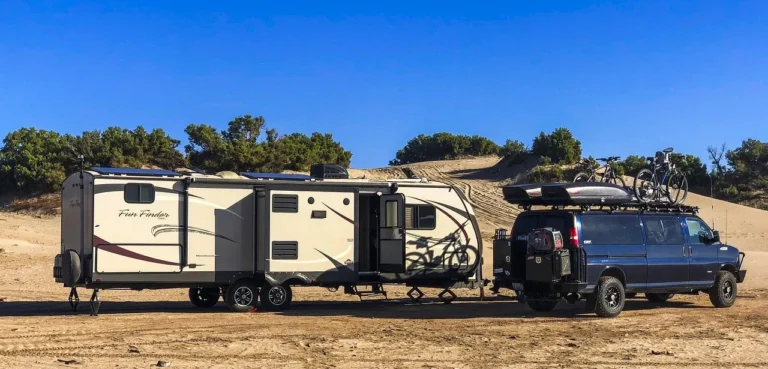
A weight distribution hitch is one of the best upgrades for towing a travel trailer, but not every trailer needs one. If your trailer is light compared with your vehicle and the back end barely dips when you hitch up, a standard ball mount may be fine. For most mid-size and larger travel trailers, though, a weight distribution hitch makes the rig safer and far more comfortable to drive.
Here’s how to tell whether you need one, what it actually does, and what it costs.
What a Weight Distribution Hitch Does
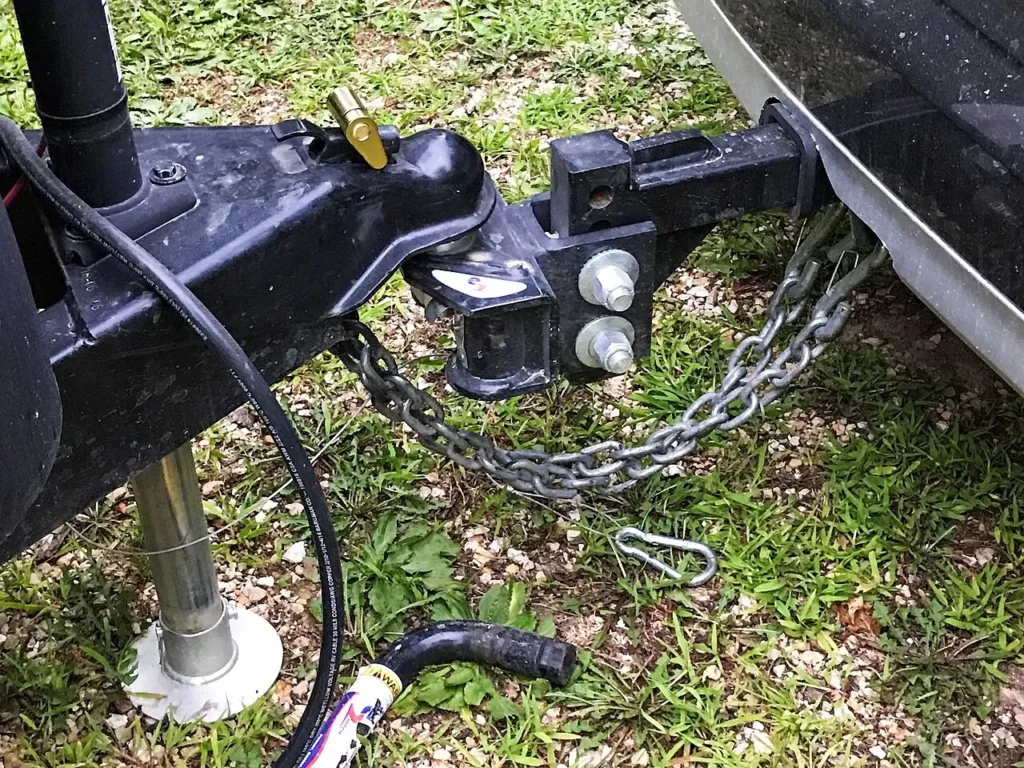
A trailer hooked up with a weight distribution head and safety chains | Photo: Tony Webster, CC BY-SA 2.0
When you drop a trailer’s tongue onto a regular ball hitch, all of that weight pushes down on the back of your vehicle. The rear squats, the nose lifts, and weight comes off the front wheels. That’s the problem, because your front wheels do the steering and much of the braking.
A weight distribution hitch uses spring bars that attach between the hitch head and the trailer frame. When they’re tensioned, they act like a lever and spread part of the tongue weight forward to the vehicle’s front axle and back to the trailer’s axles. The result is a level rig with the front wheels firmly on the road.
Most modern weight distribution hitches also include sway control, usually friction or cam-based, which resists the side-to-side movement that wind and passing trucks can cause.
One thing it does not do: raise your vehicle’s towing capacity. It helps you use your existing ratings safely, but it never lets you exceed them.
Do You Need One? Five Ways to Tell
1. Your vehicle maker says so
This is the first check. Many owner’s manuals and towing guides require a weight-distributing hitch above a certain trailer weight. Ford’s towing guide, for example, says most applications pulling trailers over 5,000 pounds need a conventional weight-distributing or fifth-wheel hitch. Look up the rule for your exact vehicle.
2. Your hitch receiver has two ratings
Many receivers list a weight-carrying rating and a higher weight-distributing rating. If your trailer or tongue weight is above the weight-carrying number, you need a weight distribution system to use the higher one. Remember that your whole setup is only as strong as its lowest-rated part.
3. The trailer is more than about half your vehicle’s weight
A common rule of thumb, used by hitch maker Andersen, is to use weight distribution when the trailer weighs more than half your tow vehicle’s GVWR. For a truck with a 6,000-pound GVWR, that’s any trailer over about 3,000 pounds.
4. Your vehicle squats when you hitch up
If you can see the back end drop and the headlights point up, too much weight is sitting on the rear axle. etrailer gives the same simple test: visible sag, or a vehicle that feels harder to handle, means you need weight distribution.
5. Towing feels light or wandering
Vague steering, a floaty front end or sway when trucks pass are signs the front axle has lost too much weight.
If none of these apply, as with a small teardrop behind a full-size truck, a standard hitch with the right ball mount may be all you need. Our guide to RV weight terms explains tongue weight, GVWR and payload if you need to check the numbers.
What a Weight Distribution Hitch Costs
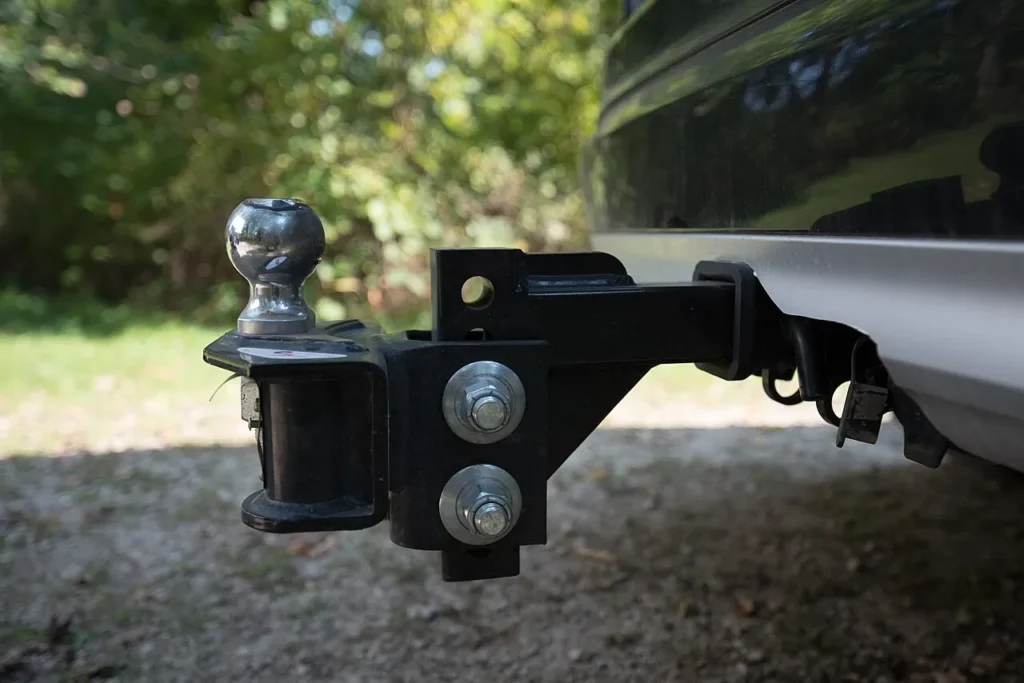
The hitch head, with a ball and spring-bar sockets, slides into your receiver | Photo: Tony Webster, CC BY 2.0
At the time of writing (November 2026), popular systems sell for roughly:
| Hitch | Typical price |
|---|---|
| Equal-i-zer 4-point sway control | About $650 to $875 |
| Blue Ox SwayPro | About $850 to $1,090 |
Prices depend on the weight rating, shank size and retailer. Higher-end hitches that eliminate sway through different geometry cost more. Some dealers include a basic hitch with a new trailer, so ask before you buy separately. Choose a rating that matches your trailer’s loaded tongue weight, not its dry weight.
Setting It Up Properly
A weight distribution hitch only works if it’s adjusted for your vehicle and trailer. Follow the hitch maker’s instructions, which usually involve measuring your front fender height before and after hitching, then adjusting the hitch head angle and spring bar tension. Many RV dealers will set it up for you at delivery, and it’s worth re-checking whenever you change trailers, vehicles or how you load.
For the full hitching routine, see our guide on how to tow a travel trailer.
Final Thoughts
You need a weight distribution hitch if your vehicle maker requires it, your receiver’s weight-carrying rating is too low, or your vehicle squats and steers poorly with the trailer attached. For most mid-size travel trailers, it’s money well spent. Pair it with a truck that has the payload to match; our guide on what size truck you need helps you check.
FAQs
Does a weight distribution hitch increase towing capacity?
No. It helps you tow within your existing ratings more safely, but it never raises your vehicle’s maximum towing capacity or payload.
Do I need a weight distribution hitch with a half-ton truck?
Often, yes, for mid-size travel trailers. Half-ton trucks have lower payloads and softer rear suspensions, so they benefit most.
Can I use a weight distribution hitch with surge brakes?
Check with the hitch maker. Some systems aren’t compatible with surge brakes, which are more common on boat trailers than travel trailers.