
Managing money abroad requires more planning than simply exchanging currency before departure. ATM withdrawal charges, foreign transaction fees, and unfamiliar payment systems can all affect your travel budget. While some destinations rely heavily on cash, others increasingly accept digital payments for hotels, restaurants, shopping, and transportation.
When comparing cash vs card travel options, neither method is perfect. Carrying some local currency alongside a reliable international payment card usually offers the best balance of convenience, flexibility, and security.
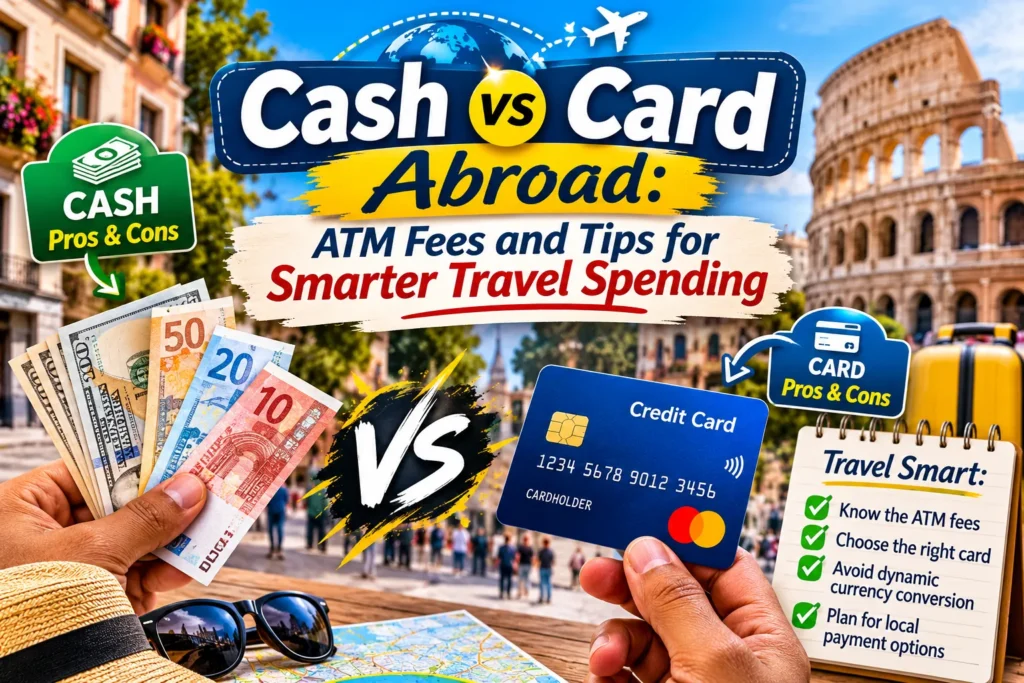
1. Using Cash Abroad: Benefits and Drawbacks
Cash remains essential in many international destinations, particularly for smaller purchases and businesses that do not accept cards. It is useful for street food, local markets, public transportation, tips, and independent vendors. Cash can also make budgeting easier because you can set aside a specific amount for daily expenses.
However, exchanging currency may involve unfavorable rates, while carrying large amounts increases the risk of theft or loss. The best approach is to exchange or withdraw a reasonable amount rather than converting your entire travel budget at once.
2. Paying by Card Abroad: Why It Is Convenient
International debit and credit cards make managing travel expenses easier, especially in destinations where electronic payments are widely accepted.
You can use them for hotel reservations, restaurant bills, shopping, transportation, and online bookings without carrying large amounts of cash.
Another advantage is expense tracking. Banking applications allow you to monitor transactions and manage spending throughout your trip.
However, some banks charge foreign transaction fees, currency conversion fees, or international withdrawal charges. Before traveling, check your card’s international payment fees and confirm that overseas transactions are enabled.
3. Understanding ATM Fees When Traveling
Withdrawing local currency from an ATM is often more convenient than exchanging large amounts at an airport. However, international withdrawals may involve several charges:
- Foreign ATM fees: Your home bank may charge a fixed fee for withdrawals outside your country.
- Currency conversion fees: Some banks apply an additional percentage when converting foreign currency.
- Local ATM charges: The ATM operator may charge a separate withdrawal fee.
- Out-of-network fees: Some banks charge extra when you use ATMs outside their approved networks.
These costs can accumulate quickly, particularly when making several small withdrawals.
To reduce expenses, use reputable bank-operated ATMs, check your bank’s withdrawal policy, and avoid unnecessary transactions.
4. Dynamic Currency Conversion: A Fee to Watch Out For
Dynamic currency conversion (DCC) occurs when a card terminal or ATM offers to process a payment in your home currency instead of the local currency.
Although this may seem convenient, the exchange rate is often less favorable than the rate provided by your card network or bank.
For example, when shopping in France, a payment terminal may ask whether you want to pay in euros or your home currency. Choosing euros generally allows your card provider to handle the conversion.
The same principle applies to ATM withdrawals. Whenever possible, select the local currency and decline the ATM’s conversion offer to avoid unnecessary exchange-rate markups.
5. Cash vs Card Abroad: Which Is Better for Different Expenses?
The best payment method depends on your destination and spending habits.
| Travel Expense | Recommended Payment |
|---|---|
| Hotels and accommodation | Card |
| Restaurants and cafés | Card or cash |
| Public transportation | Either |
| Local markets and street vendors | Cash |
| Shopping and entertainment | Card |
| Tips and small purchases | Cash |
| Emergencies | Both |
Cards are particularly useful for larger purchases, hotel deposits, and online bookings. Cash remains valuable for smaller businesses, traditional markets, and situations where electronic payments are unavailable.
Using both methods provides greater flexibility than relying entirely on one.
6. How to Avoid Expensive ATM and Currency Exchange Fees
A few simple decisions can help reduce unnecessary banking charges while traveling.
- Use bank-operated ATMs: Machines inside established bank branches are generally preferable to unfamiliar standalone machines.
- Withdraw larger amounts less frequently: This can reduce fixed withdrawal charges, provided you can store the money securely.
- Compare exchange rates: Check rates offered by your bank and currency exchange providers.
- Avoid unnecessary airport exchanges: Airport currency counters may offer less competitive rates.
- Check foreign transaction fees: Understand your card’s international payment and withdrawal charges before departure.
- Decline unfavorable conversion offers: Choose local currency when paying or withdrawing money abroad.
7. Essential Safety Tips for Carrying Money Abroad
Protecting your money is just as important as choosing the right payment method.
Consider these precautions:
- Separate your money: Keep cash, your primary card, and backup card in different secure locations.
- Avoid carrying excessive cash: Take only what you reasonably expect to spend.
- Use secure ATMs: Choose machines inside banks or reputable shopping centers.
- Protect your PIN: Cover the keypad when entering your details.
- Enable transaction alerts: Notifications can help you identify suspicious activity.
- Save emergency contacts: Keep your bank’s contact information somewhere separate from your wallet.
- Carry a backup card: A second card can help if your primary one is blocked, damaged, or stolen.
Before departure, also check how to freeze or report a missing card.
8. What Is the Best Way to Manage Money Abroad?
For most international travelers, combining cash and cards offers the greatest flexibility. Use cards for larger expenses such as accommodation, shopping, restaurant bills, and transportation where electronic payments are accepted. Keep some local currency for markets, tips, smaller purchases, and businesses that do not accept cards.
Before departure, estimate your daily spending needs and check whether reliable ATMs are available at your destination, especially if you plan to visit smaller towns or remote areas. Most importantly, avoid depending entirely on one payment method. Having alternatives makes unexpected situations easier to manage.
Final Thoughts
Choosing between cash and cards abroad does not have to be an either-or decision. Both methods offer advantages, and understanding their associated costs can help you manage your travel budget more effectively. Cards provide convenience, easier expense tracking, and reduced dependence on physical currency, while cash offers flexibility for smaller purchases and destinations with limited electronic payment options.
The smartest approach to cash vs card travel is to combine both, compare international fees before departure, choose local currency when paying, and keep your money secure.