
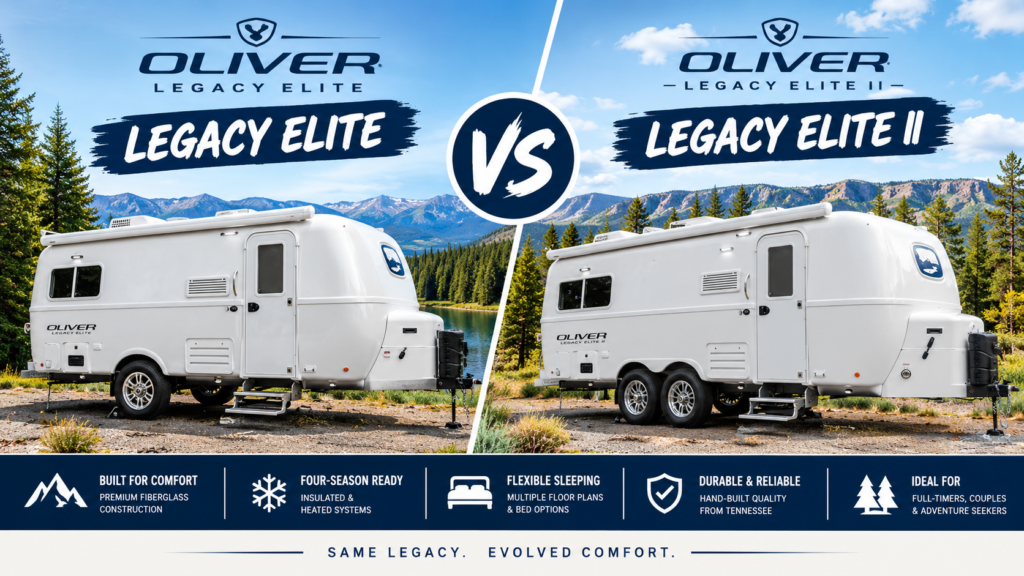
Before comparing a single spec, here’s something that changes the entire question: as of the 2026 model year, Oliver’s Legacy Elite the smaller, single-axle trailer is completely sold out. Oliver’s own site lists it as “Fully Booked” with every production slot for the year reserved, and directs shoppers straight to the Legacy Elite II instead.
So for most people asking “Legacy Elite vs Legacy Elite II,” the honest first answer is: you may not currently have a choice. If you want a new Oliver this year, it’s the Elite II or nothing, unless you’re willing to buy used or wait for the next production run.
With that reality set, here’s how the two compare on their merits, for anyone deciding which to wait for, which to hunt for used, or which fits their camping style better long-term.
Head-to-Head Specs
This is pulled directly from Oliver’s own comparison page, so these numbers are as authoritative as it gets — no dealer guesswork.
| Specification | Legacy Elite | Legacy Elite II |
| Exterior length | 18′ 5″ | 23′ 6″ |
| Exterior width | 6′ 6″ | 7′ 0″ |
| Exterior height (to top of A/C) | 9′ 2″ | 9′ 7″ |
| Interior height | 6′ 1″ | 6′ 6″ |
| Interior width | 6′ 2″ | 6′ 7″ |
| Dry weight (base) | 3,700 lb | 4,900 lb |
| GVWR | 5,000 lb | 7,000 lb |
| Net carrying capacity | 1,300 lb | 2,100 lb |
| Tongue weight (approx.) | 370 lb | 490 lb |
| Fresh water | 32 gal | 32 gal |
| Gray water | 32 gal | 32 gal |
| Black water | 15 gal | 15 gal |
| Axles | Single, 5,200 lb Dexter torsion | Tandem, 3,500 lb Dexter torsion |
| Brakes | 12″ electric | 10″ electric |
| Sleeps | 3 (seats up to 6) | 3 (seats up to 7) |
| Floor plans | 1 (Standard) | 2 (Standard, Twin Bed) |
| Starting price | $69,995 | $85,000 |
The Number That Matters Most: Cargo Capacity
Net carrying capacity is where the real gap opens up. The Legacy Elite gives you 1,300 lb to work with. The Legacy Elite II gives you 2,100 lb a 62% increase.
For two people traveling with camping gear, clothes, food, and the usual extras, 1,300 lb on the Elite is workable but tight, especially once you factor in a full fresh tank (roughly 266 lb) and two people’s body weight if you’re weighing at the scale with passengers aboard. The Elite II’s extra 800 lb of headroom is the difference between careful packing and not thinking about it.
If you plan to add lithium batteries, solar, or carry bikes and outdoor gear, the Elite II’s cargo capacity advantage is the more important number on this whole page.
Power Systems: Where the Elite II Pulls Ahead
This is a newer development in the Oliver lineup, and it’s a meaningful differentiator. The Legacy Elite II now ships in tiered power configurations, while the base Legacy Elite has no such tier system — it comes with a plug-and-play port for portable solar panels, but no built-in lithium or solar package as standard.
Legacy Elite II power tiers:
| Trim | Lithium Battery | Inverter | Solar |
| Standard | 100Ah | — | — |
| Premium | 200Ah | 2,000W | 400W roof |
| Platinum | 320Ah | 3,000W | 400W roof |
| Platinum Pro | 640Ah | 3,000W | 1,360W total |
Every trim still includes all 85 standard features the difference is purely what’s on the roof and in the battery bay. If extended off-grid capability matters to you, this tier system doesn’t exist on the smaller Elite, which is another point in the Elite II’s favor for boondockers.
Construction: Identical Where It Counts
Both trailers share Oliver’s core engineering, and this is really the heart of the brand’s whole pitch:
- Double-hull molded fiberglass four separate fiberglass pieces per shell, with insulation sandwiched between an inner and outer layer
- Plumbing, tanks, and drain pipes enclosed between the shells with heat to resist freezing genuine four-season protection, not just a marketing label
- Aircraft-grade aluminum frame with galvanized steel sub-assembly
- Dexter “Nev-R-Lube” axles with electric brakes
- On-demand tankless water heater, ducted furnace, and Dometic A/C as standard
- EZ winterizing system
The build quality story is identical between the two. You’re not trading construction quality for size — you’re only trading dimensions, weight, and cargo capacity.
Layout: Bed Configuration Is the Real Choice
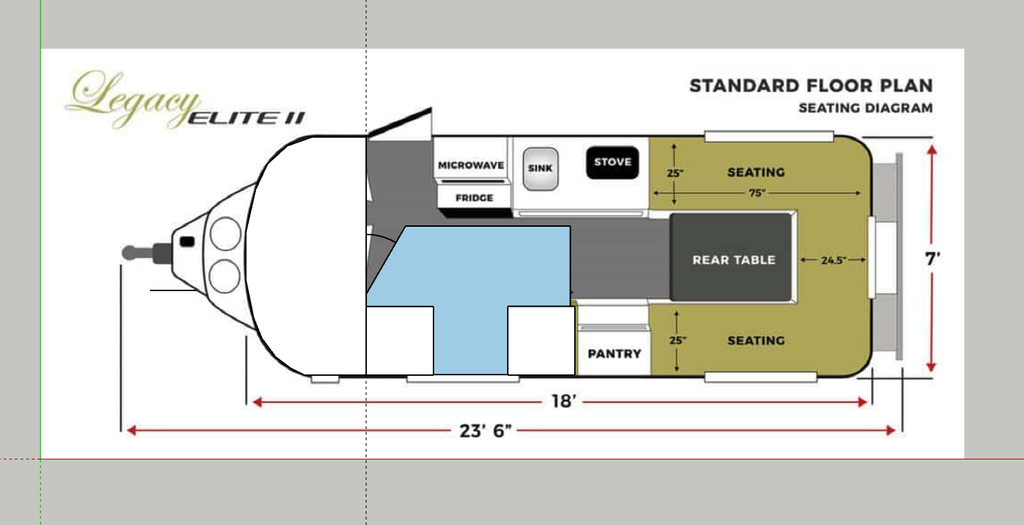
The Legacy Elite has one floor plan: a rear dinette that seats up to 6 and converts to a 52″ x 74″ bed, plus a side dinette that converts to a smaller single bed.
The Legacy Elite II offers two:
- Standard, where the rear dinette seats up to 7 and converts to a 75″ x 79″ bed (effectively king-sized)
- Twin Bed, with two separate 75″ x 30″ twin beds in the rear, each with its own nightstand and storage drawer
The Twin Bed layout is a genuine point of difference the Elite doesn’t offer at all — useful for two people who don’t want to share a bed, or for anyone who occasionally travels with a third adult. If that layout appeals to you, it’s exclusive to the Elite II.
What They Actually Cost
Oliver sells factory-direct with no-haggle pricing, which makes this one of the more transparent brands to research.
New:
- Legacy Elite: $69,995 starting (when available — currently sold out for 2026)
- Legacy Elite II: $85,000 starting for the base Standard trim; Platinum Pro trims run higher
Used:
- Legacy Elite II used and new listings on the secondary market currently span roughly $57,000 to $99,850, averaging around $99,500 for well-equipped units
- Used Legacy Elite pricing is harder to pin down; sparse used inventory reflects genuinely strong owner retention
The resale story is a real selling point for the brand. Olivers are known to hold value better than almost any towable RV on the market — a direct consequence of the double-hull construction and Oliver’s small, devoted owner base. If resale matters to your decision, either model should serve you better than a typical stick-and-staple trailer.
The Honest Trade-Offs (Both Models)
No Oliver review is complete without naming these, since they apply to both trailers equally:
- Price per foot is high. These are among the most expensive trailers you can buy relative to their size.
- Factory-direct means factory-distance service. Major warranty work generally means a trip to Hohenwald, Tennessee, since Oliver doesn’t sell through a wide dealer network.
- Curved walls and a compact cabin limit storage compared to a boxy stick-built trailer of the same length.
- Sealed fiberglass shells can trap condensation. Owners manage this with liners and active ventilation — it’s a known characteristic of the double-hull design, not a defect, but worth knowing before you buy.
Which Should You Buy?
Go with the Legacy Elite if you:
- Want the smallest, lightest option genuinely towable by a half-ton SUV, not just a truck
- Are a solo camper or couple who travels light
- Don’t need built-in solar or lithium
- Are comfortable waiting for the next production run or buying used
Go with the Legacy Elite II if you:
- Want meaningfully more cargo capacity and interior room
- Are interested in off-grid power (lithium, solar, a real inverter)
- Want the option of a Twin Bed floor plan
- Need to buy new right now, since it’s the only model currently in production
- Plan to tow with a half-ton truck rather than an SUV