
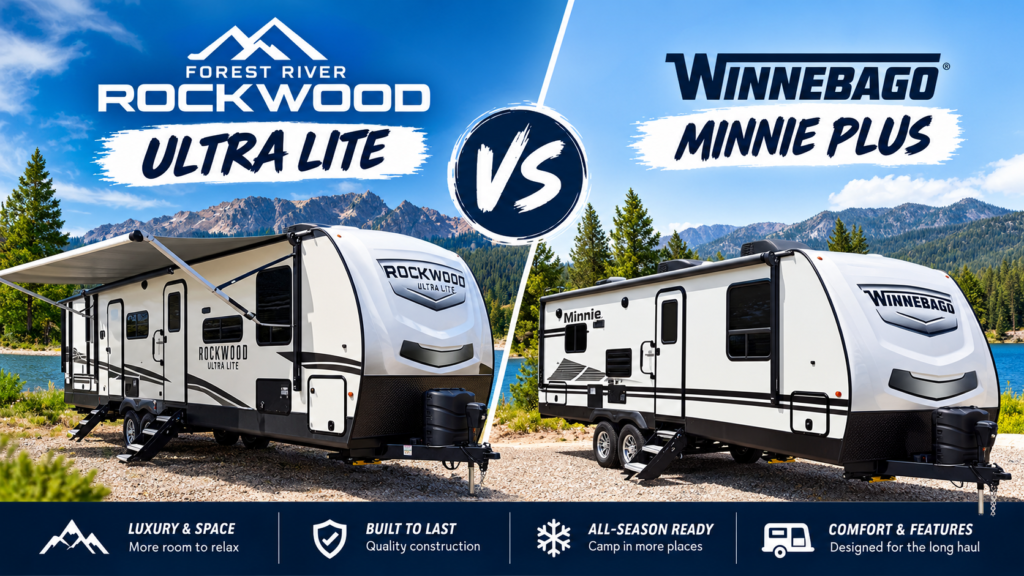
If you’ve been cross-shopping the Forest River Rockwood Ultra Lite against the Winnebago Minnie Plus for cold-weather camping on a budget, there’s something you need to know before you compare a single spec: these two trailers are no longer competing in the same market.
The Rockwood Ultra Lite is a current, in-production line you can order new. The Winnebago Minnie Plus travel trailer has been discontinued — Winnebago’s towable lineup has moved on to the Minnie, Micro Minnie, M-Series, and the newer Thrive, and even the standard Minnie is now listed as dealer stock only. If you want a Minnie Plus, you’re shopping the used market.
That single fact reshapes the whole comparison, and it’s mostly good news for budget buyers. Here’s how the two actually stack up on specs, cold-weather capability, cargo capacity, and cost.
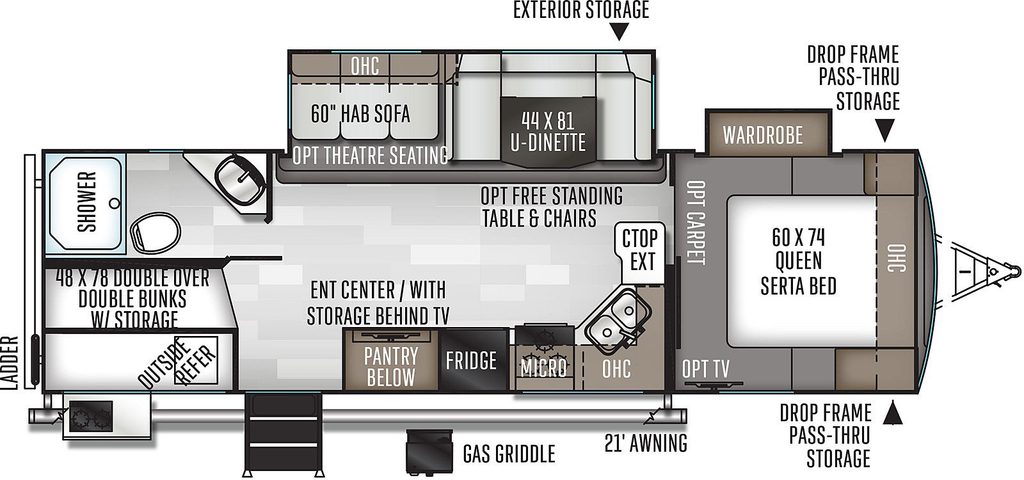
Both lines span many floor plans, so comparing line averages would be meaningless. Instead, here are the two closest-matched bunkhouses — the Rockwood Ultra Lite 2706WS and the Winnebago Minnie Plus 27BHSS. Both are rear-bunkhouse family trailers with outside kitchens in the low-30-foot range, and both are the most popular plan in their respective lines.
| Specification | Rockwood Ultra Lite 2706WS | Winnebago Minnie Plus 27BHSS |
| Exterior length | 32′ 10″ | 31′ 4″ |
| Exterior width | 96″ (8’0″) | 96″ (8’0″) |
| Exterior height | 11′ 2″ | 10′ 10″ – 11′ 4″ |
| Interior height | — | 6′ 8½” |
| Dry weight | 7,310 lb | 6,620 lb |
| GVWR | Approx. 8,721 lb | 9,995 lb |
| Cargo capacity | 1,411 lb | Approx. 3,375 lb |
| Dry hitch weight | 921 lb | 760 lb |
| Fresh water | 54 gal | 50 gal |
| Gray water | 90 gal | 69 gal |
| Black water | 45 gal | 28 gal |
| Furnace | Automatic | 30,000 – 35,000 BTU |
| Water heater | 6 gal | 10 gal |
| Slide-outs | 2 | 1 |
| Entry doors | 2 | 1 |
| Awning | 21′ power | 20′ |
| Max sleeping capacity | Up to 10 | Up to 8 |
Rockwood figures are from the 2021 model year; Minnie Plus figures are from Winnebago’s 2019–2020 brochures. Specs varied by year on both lines a 2017 Minnie Plus 27BHSS, for instance, was a shorter 27′ 8″ unit. Always verify against the specific unit you’re looking at.
The Number That Decides This Comparison: Cargo Capacity
Look past dry weight and at what each trailer can legally carry. This is where the two diverge dramatically, and it’s the most under-discussed spec in RV shopping.
The Minnie Plus 27BHSS has a dry weight of 6,620 lb against a GVWR of 9,995 lb. That leaves roughly 3,375 pounds of cargo capacity. The Rockwood Ultra Lite 2706WS, despite being a foot and a half longer, has just 1,411 pounds.
That’s a difference of nearly a ton, and it has real consequences. Filling the Rockwood’s 54-gallon fresh tank consumes about 448 pounds — nearly a third of its total capacity before you’ve loaded a single sleeping bag. Add two batteries, a full propane load, bedding, food, camp chairs, a generator, and five people’s clothes, and a 2706WS gets tight fast. Families who load heavy genuinely do run out of payload on this trailer.
The Minnie Plus, meanwhile, will comfortably absorb everything you can fit through the door.
The catch: that 9,995 lb GVWR means a loaded Minnie Plus can weigh nearly 10,000 pounds, which pushes past comfortable half-ton territory. The Rockwood’s lower GVWR makes it easier to tow legally with a half-ton truck — precisely because it can’t carry as much. Neither approach is wrong. They’re different trade-offs, and which one suits you depends entirely on whether your constraint is your truck or your gear.
Cold-Weather Capability: Which Is Actually the Better Four-Season Trailer?
Neither of these is a true four-season trailer in the way an Arctic Fox or Outdoors RV is. Both are three-season trailers with cold-weather packages that extend the shoulder seasons. But they’re not equal.
Rockwood Ultra Lite — Climate Protection Package:
- 12V thermostatically controlled heated holding tanks
- Radiant foil in the front cap, underbelly, and slide-outs
- Enclosed underbelly
- AeroCore Climate laminated foam ducting system
Winnebago Minnie Plus — Extreme Weather Package:
- Radiant reflective insulation technology
- 30,000–35,000 BTU furnace
- Enclosed underbelly
The Rockwood wins this category, primarily because of thermostatically controlled heated tanks. Radiant reflective insulation slows heat loss, but heated tanks actively prevent your fresh, gray, and black water from freezing — the single failure point that ends most cold-weather trips. The AeroCore ducting also distributes furnace heat more evenly than a conventional system.
The Minnie Plus counters with a bigger water heater (10 gallons versus 6), which matters more than you’d think in cold weather when everyone wants a hot shower.
Honest assessment for both: plan on comfortable camping down to around freezing, with the Rockwood handling sustained sub-freezing better. For genuine winter camping in Montana or Minnesota, look at a dedicated four-season build instead.
Off-Grid and Solar
This is a clean win for the Rockwood, and it reflects the six-year gap in when these trailers were designed.
Current Rockwood Ultra Lite models come standard with a 200W roof solar panel, an inverter, a 30-amp charge controller, additional solar prep for a second panel, double battery boxes, and double 30 lb propane tanks. Recent model years also add WiFi prep and backup camera prep.
The Minnie Plus was designed before solar became a standard expectation. Most used units have solar prep at best, and many have nothing. Budget $1,500 to $3,000 to add a comparable system if boondocking matters to you — and factor that into any price comparison you’re running.
Layout and Livability
The Rockwood 2706WS uses two slide-outs and two entry doors. The dual slides create a noticeably more open main living area, and the second entry door — opening directly into the rear bunkhouse — is a feature families consistently rate highly. Kids can come and go without tracking mud through the kitchen, and it doubles as a second emergency exit.
The Minnie Plus 27BHSS runs a single slide-out and one entry door with a domed ceiling for added headroom and minimal carpet, which makes it easier to clean.
The Rockwood also offers more sleeping capacity (up to 10 versus 8) and a longer 21-foot power awning.
On tank capacity: the Rockwood’s 90-gallon gray and 45-gallon black tanks are substantially larger than the Minnie Plus at 69 and 28 gallons. If you camp without hookups for stretches, that’s roughly an extra day or two between dump runs.
What Each One Costs
This is where the discontinued status turns into a genuine opportunity.
Forest River Rockwood Ultra Lite 2706WS:
| Model Year | Price |
| 2020 | Roughly $41,500 MSRP |
| 2021 | $45,016 MSRP |
| 2023 | Roughly $60,500 MSRP |
Winnebago Minnie Plus (used market):
| Configuration | Typical Asking Price |
| Minnie Plus, all floor plans | Roughly $14,500 – $31,300 (average around $24,300) |
| 2017 27BHSS | Roughly $15,000 – $22,000 |
| 2018 27BHSS | Roughly $24,000 |
| 2019 27BHSS | Roughly $21,000 – $24,000 |
| 2017 26RBSS | Roughly $12,500 |
The gap is stark. A well-kept 2019 Minnie Plus 27BHSS at around $22,000 costs roughly a third of a new Rockwood 2706WS, and you get more cargo capacity and a bigger water heater in the bargain.
What you give up: warranty coverage, standard solar, the second slide and second door, larger tanks, heated tanks, and the reassurance of buying something still supported in production.
Reliability and Ownership Notes
Both are mass-market trailers built to a price, and both attract the fit-and-finish complaints typical of the category.
Rockwood owners report stripped cabinet hinge screws, adhesive-mounted trim coming loose, and occasional electrical faults. Forest River warranty service draws mixed reviews, particularly where the selling dealer has changed ownership. On the positive side, RV Guide has ranked the 2706WS #1 out of 477 Forest River travel trailers in its model year, and long-term owners are frequently enthusiastic.
Minnie Plus owners have reported water intrusion around the slide-out and a poorly positioned city water connection that’s awkward to tighten. Winnebago’s construction uses the well-regarded BAL NXG frame, and the brand generally carries a better build-quality reputation than the mass-market average.
Since every Minnie Plus is now a used purchase, a professional pre-purchase inspection is essential — not optional. Prioritize checking the slide seals and looking for any history of water damage, which is the failure that turns a cheap trailer into an expensive mistake.
Which Should You Buy?
Go with the Forest River Rockwood Ultra Lite if you:
- Want a new trailer with warranty coverage
- Need the best shoulder-season performance of the two
- Want standard solar without aftermarket work
- Value dual slides, a second entry door, and bigger waste tanks
- Tow with a half-ton truck and want to stay comfortably within its limits
- Are sleeping seven or more people
Go with the Winnebago Minnie Plus if you:
- Are shopping used and want maximum trailer per dollar
- Load heavy and need real cargo capacity
- Have a three-quarter-ton truck that can handle a 9,995 lb GVWR
- Don’t mind adding solar yourself
- Are comfortable commissioning a thorough pre-purchase inspection