
Standard travel insurance will reimburse you for cancelling a trip but only for reasons it approves of. Get sick, lose a family member, get called for jury duty, and you’re covered. Get cold feet, change your mind, or just decide you’d rather not go anymore, and a standard policy pays you nothing.
Cancel For Any Reason (CFAR) coverage exists to close that gap. It’s the only travel insurance benefit that pays out regardless of why you cancel but it comes with real trade-offs most people don’t fully understand until they try to file a claim. Here’s exactly how it works, what it costs, and the rules that catch travelers out most often.

What CFAR Actually Is
CFAR is not a standalone insurance policy. It’s an optional upgrade you add on top of a comprehensive travel insurance plan you can’t buy CFAR by itself, and it only exists bolted onto a base policy that already includes standard trip cancellation coverage.
What it buys you: the ability to cancel your trip for literally any reason anxiety about travel, a work conflict, a family event that came up, simply changing your mind and still receive a partial refund of your prepaid, non-refundable costs.
The trade-off is in that word “partial.” CFAR typically reimburses 50% to 75% of your insured trip cost. Compare that to standard cancellation coverage, which pays 100% but only for a specific, approved list of reasons.
CFAR vs. Standard Trip Cancellation

Feature | Standard Trip Cancellation | CFAR |
|---|---|---|
| Reason required | Must match a “covered reason” (illness, injury, death in the family, severe weather, jury duty, certain job losses) | Any reason at all, including personal choice |
| Reimbursement | Up to 100% of insured trip cost | Typically 50–75% of insured trip cost |
| Standalone purchase | Part of most comprehensive plans | Add-on only — cannot be purchased alone |
| Purchase window | Often available any time before departure | Must typically be added within 14–21 days of your first trip payment |
| Cancellation deadline | Varies by covered reason | Must usually cancel at least 48–72 hours before departure |
The core logic: standard cancellation coverage is narrower but pays in full. CFAR is dramatically broader but pays partially. They’re not competing products most people who buy CFAR are buying it as an upgrade to, not instead of, standard coverage.
The Three Rules That Catch People Out
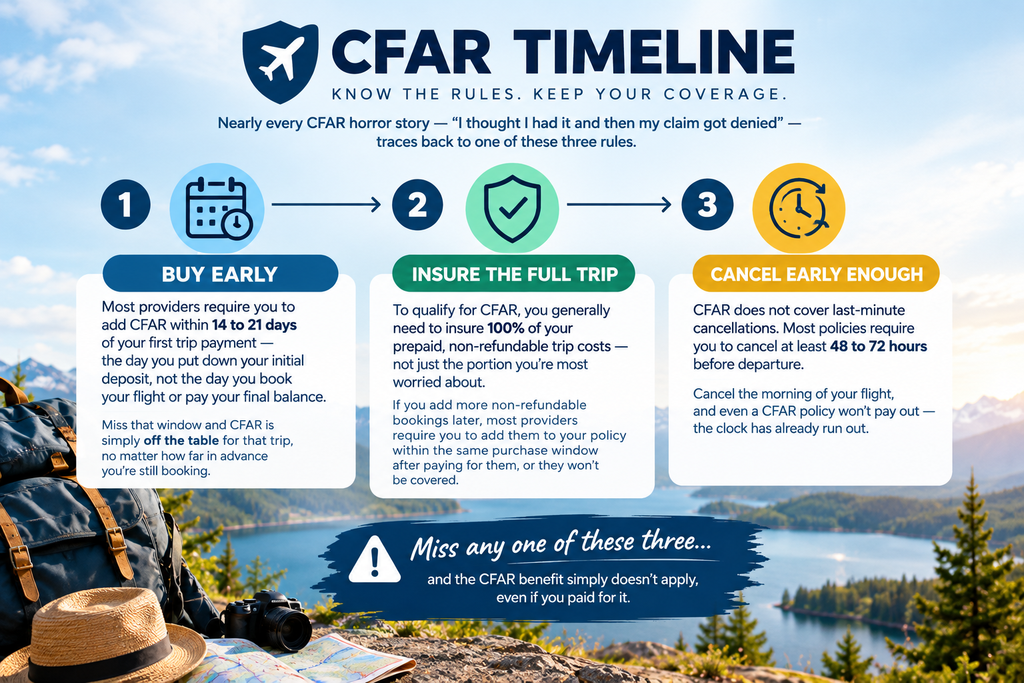
Nearly every CFAR horror story “I thought I had it and then my claim got denied” traces back to one of these three rules.
1. You have to buy it early. Most providers require you to add CFAR within 14 to 21 days of your first trip payment the day you put down your initial deposit, not the day you book your flight or pay your final balance. Miss that window and CFAR is simply off the table for that trip, no matter how far in advance you’re still booking.
2. You have to insure the full trip. To qualify for CFAR, you generally need to insure 100% of your prepaid, non-refundable trip costs not just the portion you’re most worried about. If you add more non-refundable bookings later, most providers require you to add them to your policy within the same purchase window after paying for them, or they won’t be covered.
3. You have to cancel early enough. CFAR does not cover last-minute cancellations. Most policies require you to cancel at least 48 to 72 hours before departure. Cancel the morning of your flight, and even a CFAR policy won’t pay out the clock has already run out.
Miss any one of these three and the CFAR benefit simply doesn’t apply, even if you paid for it.
How Much Does CFAR Cost?
Base comprehensive travel insurance typically runs 4% to 10% of your total trip cost. Adding CFAR increases that to roughly 6% to 18% of trip cost, depending on the provider and plan in practice, CFAR usually adds somewhere around 40% to 60% on top of what the base policy would have cost on its own.
A worked example: say your trip costs $6,000 and your CFAR reimbursement rate is 75%. If you have to cancel for a reason your base policy doesn’t cover say, you simply decide not to go CFAR gets you back $4,500. Without it, you’d recover nothing for an uncovered reason.
Whether that math works in your favor depends entirely on how non-refundable your trip actually is. A trip built entirely on refundable hotel bookings and flexible flights has little to protect; a trip loaded with non-refundable tour packages, a nonrefundable cruise deposit, or prepaid all-inclusive stays has much more at stake.
Why CFAR Demand Has Spiked
Interest in CFAR coverage has risen sharply through 2026 industry data from travel insurance marketplace Squaremouth shows demand up roughly 27% since March, driven largely by travelers wanting flexibility around unpredictable global events rather than any specific medical concern. That shift reflects a broader pattern: more travelers are treating CFAR less as a medical safety net and more as general insurance against the world changing its mind for them between booking and departure.
What CFAR Does and Doesn’t Cover
CFAR covers, broadly:
- Changing your mind for any personal reason
- Work conflicts or schedule changes
- Anxiety or discomfort about traveling, including to a specific destination
- Family circumstances that don’t meet a standard policy’s strict definitions
- Essentially any reason not explicitly covered by your base policy, provided you follow the purchase-window and cancellation-deadline rules
What CFAR doesn’t change:
- It doesn’t increase your reimbursement rate above its stated percentage, even for a reason that would otherwise be covered at 100% under your base policy if a covered reason applies, claim under standard cancellation instead and get the higher payout.
- It doesn’t cover costs you didn’t insure. If you under-insured your trip value, your reimbursement is capped accordingly.
- It doesn’t help with a cancellation made too close to departure the 48–72 hour rule is firm.
Is CFAR Worth It?
This isn’t a yes-or-no answer it depends on three things specific to your trip:
How much of your trip is genuinely non-refundable. If most of your costs are refundable or low-risk, CFAR has little to protect and is probably not worth the premium.
How much uncertainty surrounds your plans. If you’re booking far in advance, dealing with a situation that might change (a flexible work schedule, a health situation that isn’t yet a “covered reason,” evolving travel conditions at your destination), CFAR’s broad eligibility is exactly the kind of protection standard coverage can’t offer.
Whether a 50–75% reimbursement is enough to matter. CFAR is not a full refund. If losing half your trip cost wouldn’t meaningfully change your situation, the premium may not be worth paying. If it would, CFAR is one of the only tools that protects against the reasons standard insurance won’t touch.
A reasonable rule of thumb: if your trip is expensive, mostly non-refundable, and booked far enough in advance that your circumstances could plausibly change before departure, CFAR is usually worth pricing out. If your trip is cheap, mostly refundable, or close to departure already, it rarely pays for itself.
How to Buy CFAR Correctly
- Buy comprehensive travel insurance immediately after your first trip deposit — not after your final payment. The CFAR purchase window starts counting from your first payment, and it’s short.
- Insure 100% of your trip’s prepaid, non-refundable cost, not just part of it.
- Add later bookings to your policy within the same window after you pay for them, if your trip has staged payments.
- Mark your calendar for the cancellation deadline generally 48 to 72 hours before departure and don’t wait until the last minute to decide.
- Compare CFAR reimbursement percentages across providers. 50% and 75% are very different outcomes on an expensive trip, and the percentage varies by plan, not just by provider.
Frequently Asked Questions
What does Cancel For Any Reason (CFAR) insurance actually cover? It covers cancelling your trip for literally any reason personal choice, work conflicts, anxiety about travel, or anything else not on a standard policy’s approved list — and reimburses typically 50% to 75% of your prepaid, non-refundable trip costs.
Can I buy CFAR as a standalone policy? No. CFAR is only available as an add-on to a comprehensive travel insurance plan that already includes standard trip cancellation coverage.
How soon after booking do I need to buy CFAR? Most providers require you to add CFAR within 14 to 21 days of your first trip payment or deposit not your final payment date.
Does CFAR refund 100% of my trip cost? No. CFAR typically reimburses 50% to 75% of your insured, prepaid, non-refundable costs. Only standard cancellation coverage, for an approved reason, pays out at 100%.
How close to my trip can I cancel and still use CFAR? Most policies require cancellation at least 48 to 72 hours before departure. CFAR does not cover last-minute, same-day cancellations.
How much does CFAR cost? Base travel insurance typically runs 4% to 10% of your trip cost. Adding CFAR increases that to roughly 6% to 18%, depending on the provider and plan.
The Bottom Line
CFAR solves a real, specific problem: the gap between what standard travel insurance will cover and the much longer list of reasons people actually cancel trips. It’s not a better version of trip cancellation insurance it’s a different, more flexible, more expensive version with a lower payout rate.
The math is simple once you know the rules: buy it early, insure the whole trip, and cancel with enough notice, and it genuinely pays out for reasons nothing else will touch. Buy it late, under-insure your trip, or try to use it the day before departure, and it won’t help at all regardless of how much you paid for it.