
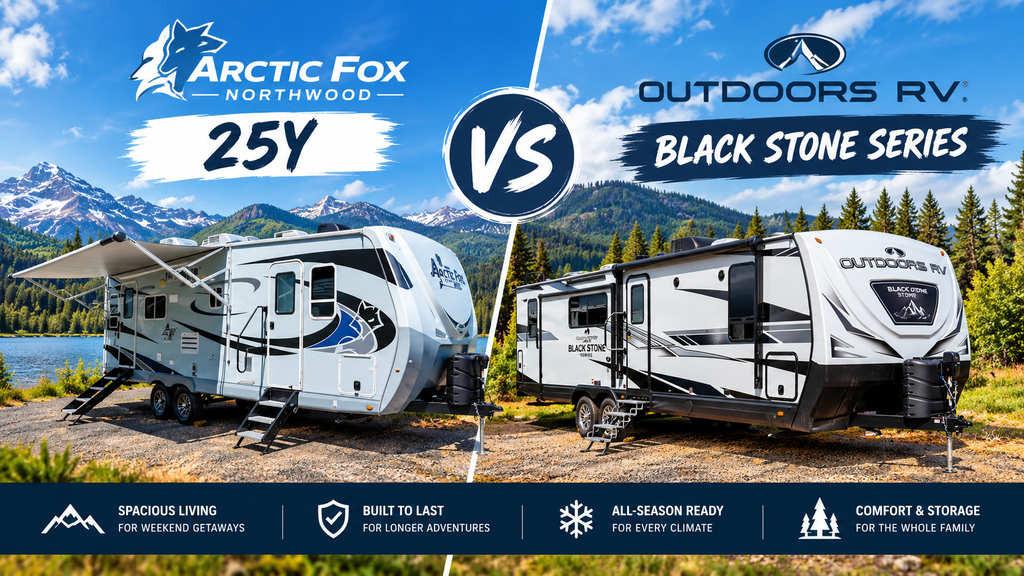
Here’s something most comparison articles won’t tell you: the Arctic Fox 25Y and the Outdoors RV Black Stone aren’t really competitors. They’re siblings.
Both trailers are built in La Grande, Oregon. Both were founded by the same couple, Ron and Sherry Nash. Both sit under the same parent company, Northwood Investments. Ron Nash started Northwood Manufacturing in 1993, creating the Arctic Fox and Nash brands, then launched Outdoors RV in 2009 after acquiring a former Fleetwood plant out of bankruptcy court. Today the two companies employ roughly 400 people between them in the same Oregon valley.
So this isn’t a battle between a good brand and a bad one. It’s a comparison between two different answers to the same question — how do you build a trailer that handles rough Western roads and genuine cold from people who learned the trade in the same building.
And the two answers diverge in one specific, decisive way. Here it is.
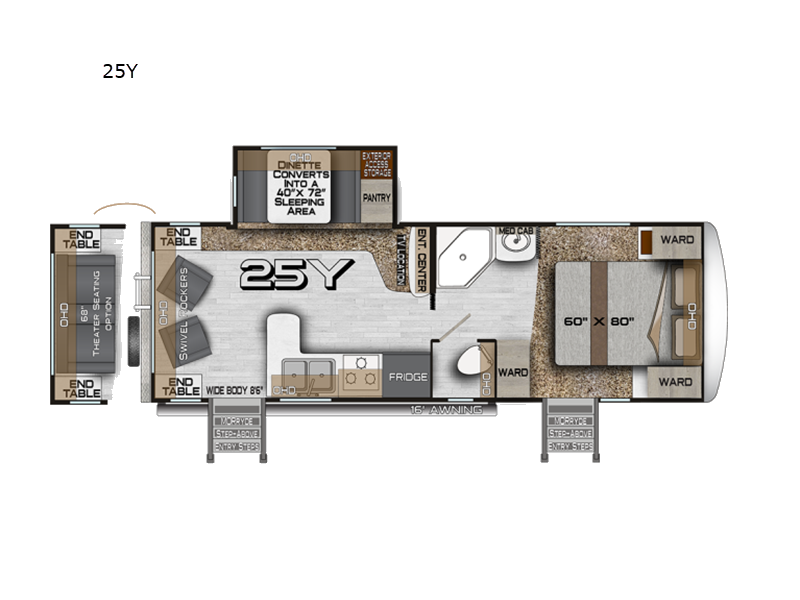
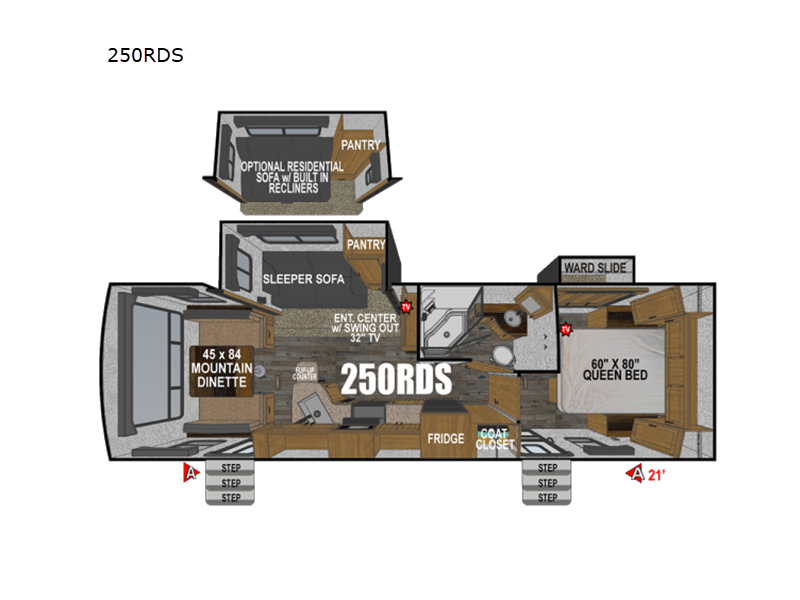
The Black Stone is a series with several floor plans, so I’ve matched the Arctic Fox 25Y against the Black Stone 260KVS — the closest-sized plan in the line. Black Stone figures are for the Mountain Series trim, since the Titanium Series is a premium package on the same shell.
| Specification | Arctic Fox 25Y | ORV Black Stone 260KVS |
| Exterior length | 30′ 0″ | 32′ 4″ |
| Floor length | — | 28′ 0″ |
| Exterior width | 102″ | — |
| Exterior height (with A/C) | 11′ 7″ | 11′ 7″ |
| Interior height | — | 6′ 11″ |
| Dry weight | 7,442 lb | 7,850 lb (Mountain) / 8,330 lb (Titanium) |
| GVWR / max trailer weight | 10,700 lb | 11,000 lb |
| Cargo capacity | 3,258 lb | 3,150 lb |
| Dry hitch weight | 802 lb | 850 lb |
| Fresh water | 57 gal | 80 gal |
| Gray water | 47 gal | 80 gal (two 40-gal tanks) |
| Black water | 35 gal | 50 gal |
| Total tank capacity | 139 gal | 210 gal |
| Water heater | 10 gal | 10 gal |
| Furnace | XL four-season | 35,000 BTU |
| Propane | Two tanks | 60 lb |
| Axles | E-Z Lube | Two 5,200 lb, 6-lug |
| Slide-outs | 1 | 1 |
The Number That Decides It: Tank Capacity
If you boondock, stop reading specs sheets top to bottom and look at one line: total water capacity.
The Black Stone 260KVS carries 80 gallons of fresh water. The Arctic Fox 25Y carries 57. That’s a 40% advantage before you even consider waste capacity — and on waste, the gap widens. The Black Stone runs two 40-gallon gray tanks for 80 gallons total against the Arctic Fox’s 47, plus a 50-gallon black tank against 35.
Add it up: 210 gallons of total capacity versus 139. In practical terms, that’s roughly 50% more time off-grid before something forces you back to civilization — and for most boondockers, it’s the gray tank that fills first and ends the trip, not the fresh tank running dry.
There’s a real cost to this. Water weighs about 8.3 pounds per gallon, so filling the Black Stone’s fresh tank consumes about 664 pounds of its 3,150 lb cargo capacity. The Arctic Fox uses roughly 473 pounds of its 3,258 lb. Both leave you plenty, but the Black Stone’s advantage only materializes if you actually have the payload headroom to fill it.
If you camp off-grid for a week or more at a time, this single spec should probably decide your purchase. No amount of insulation quality makes up for having to break camp to find a dump station.
Insulation and Cold-Weather Construction
Both brands market genuine four-season capability, and unlike most trailers making that claim, both largely earn it. But they get there differently.
Arctic Fox 25Y:
- R-18 ceiling insulation
- R-15 reflective foil insulation in the roof and slide
- Heated holding tanks
- High-density block foam insulation
- Corona-treated fiberglass laminated, multi-layered substrate walls
- Frameless thermal pane windows
- Northwood-built Ironhorse chassis with fully welded, thick-wall aluminum frame construction
ORV Black Stone (Mountain Series):
- Triple-layered four-season roof insulation: a reflective layer plus two layers of R-7 fiberglass
- Fully enclosed, heated, insulated underbelly
- Reflective insulation layer across the roof, slide-out floor, entire underbelly, and holding tanks
- Mountain Extreme thermal pane windows
- 2″ bonded aluminum frame walls on every wall
- 1″ thick thermal insulated luggage doors and exterior shower door
- XL furnace (35,000 BTU) for extreme camping
Assessment: this is close to a draw, with a slight edge to the Black Stone on comprehensiveness. Outdoors RV insulates in places most manufacturers ignore — the luggage doors and exterior shower compartment are genuinely unusual, and they matter, because those are exactly the uninsulated voids where cold gets into a trailer and freezes plumbing.
The Arctic Fox counters with a stated R-18 ceiling and a longer track record. Arctic Fox has been the default answer to “what’s a real four-season trailer” for three decades, and that reputation is earned rather than marketing.
Both routinely handle sustained sub-freezing camping that would sideline a mass-market trailer.
Off-Road and Suspension
This is where the Black Stone pulls ahead clearly, and it reflects why Outdoors RV was founded in the first place — to build trailers for Western mountain roads rather than paved campgrounds.
Black Stone standard equipment:
- Off-road X4 suspension: MorRyde CRE AllTrek 4000 with heavy-duty shackle kit
- KYB shock absorbers
- Custom-built cambered off-road chassis
- Underslung off-road hitch
- Integrated A-frame chassis construction
- Heavy-duty 6-lug 5,200 lb axles with off-road brake system
- Goodyear ST235/80/16E tires, Load Range E
- 15″ rugged mud flaps and armor-guard bumper
- Extra-tall 24″ power tongue jack
- Off-road clearance lights
Arctic Fox 25Y:
- Shocks on all four wheels
- E-Z Lube axles
- Ironhorse chassis
- Aerodynamic one-piece front cap with BackRoad Armor
The Arctic Fox is well built and no slouch on a forest service road. But the Black Stone’s MorRyde AllTrek 4000 with KYB shocks and a purpose-built cambered chassis is a genuinely more serious off-road package. If your camping involves washboard gravel and unmaintained access roads, the Black Stone will ride better and hold together longer.
Solar and Electrical
Here the Arctic Fox takes it back.
The 25Y ships with a SolX solar package and a 2,000-watt inverter as standard equipment, along with an interior command center. The Black Stone comes standard with two 200-watt FSI panels and a controller — a 400-watt baseline. Outdoors RV does offer upgrade paths (a 600-watt package adding one panel, and a 1,000-watt package adding three), plus an off-grid battery rack with capacity for four batteries, but those are options you pay extra for.
Since solar and inverter capacity are exactly what you need for extended boondocking, this partly offsets the Black Stone’s tank advantage. Be careful comparing panel counts across dealer literature, though — Arctic Fox’s SolX package is described inconsistently across sources, so confirm the actual panel count and total wattage on the specific unit you’re considering rather than trusting a spec sheet.
Net result: the Black Stone gives you more water, the Arctic Fox gives you more power out of the box. Which matters more depends on whether your limiting factor off-grid is your tanks or your batteries.
A Weight Warning That Applies to Both
This is important and under-reported, so take it seriously.
Advertised weights and GVWRs from both companies have not always matched the federal weight sticker on the actual trailer. One Arctic Fox buyer discovered at pickup that his unit’s sticker listed a GVWR of 10,000 lb rather than the advertised 10,700, with a dry weight of 8,259 lb instead of the published 7,595 — a loss of roughly 1,250 pounds of usable payload. The manufacturer later acknowledged a system error and reissued the documentation with a corrected dry weight, but the owner only caught it because he checked.
Note also that the Arctic Fox 25Y’s published dry weight has climbed substantially over the years: roughly 6,853 lb in 2015, 6,640 lb in 2021, and 7,442 lb by 2025. Same floor plan, very different numbers.
The lesson for either brand: read the yellow federal weight sticker on the specific trailer before you sign, and do the payload math yourself. Do not rely on brochure figures, and don’t assume the salesperson has checked.
Floor Plans and Layout
The Arctic Fox 25Y is a 30-foot single-slide with dual entry doors — a layout that’s been one of Northwood’s best sellers since it launched. It runs a 102-inch wide body with a cathedral arched ceiling, a 10 cubic foot refrigerator-freezer, three-burner range, and dual sink. Reviewers have flagged the microwave as undersized. Storage is a strength.
The Black Stone series offers more choice, with plans including the 250RDS, 260KVS, 270RLS, 280KVS, and 280RKS, in both Mountain Series and Titanium Series trims. The 260KVS gets a vaulted radius ceiling adding roughly five inches of headroom, XL panoramic slide-out windows, residential-height countertops, and 6’11” interior height. Titanium adds Ground Control TT auto-leveling, a 15K A/C, wireless observation and side-turn cameras, LG solid surface countertops, and knotty alder cabinet doors.
If layout flexibility matters, the Black Stone series simply has more options. If you like the 25Y’s specific dual-entry arrangement, nothing in the Black Stone line directly replicates it.
What They Cost
Neither company publishes MSRP openly, and Outdoors RV directs buyers to dealers for pricing. Black Stone Mountain Series pricing has been reported starting around $50,000, with Titanium trim and larger plans running higher.
Both are premium four-season trailers, and both cost substantially more than a comparably sized mass-market trailer. That’s the trade: you’re paying for welded aluminum framing, real insulation, and suspension that survives bad roads, rather than for square footage.
Expect meaningful dealer variation on both brands, and note that both have limited dealer networks concentrated in the Western US and Western Canada. Factor service access into your decision — owning either one two thousand miles from the nearest dealer is a real inconvenience.
Which Should You Buy?
Go with the Outdoors RV Black Stone if you:
- Boondock for extended stretches and need maximum tank capacity
- Regularly drive rough, unmaintained roads
- Want a choice of floor plans and trim levels
- Value insulated luggage doors, a 35,000 BTU furnace, and comprehensive thermal coverage
- Are willing to pay extra for a bigger solar package
Go with the Arctic Fox 25Y if you:
- Want standard solar with a 2,000-watt inverter included
- Prefer a shorter 30-foot footprint for tighter campsites
- Like the dual-entry layout specifically
- Value the longest four-season track record in the category
- Are buying used, where Arctic Fox has more inventory and a longer history to research
The Bottom Line
These are two of the few travel trailers on the market that genuinely deserve the four-season label, built by companies that share a founder, a hometown, and a philosophy. You’re not choosing between good and bad here.
For serious boondockers, the Outdoors RV Black Stone is the better tool. The tank capacity advantage is decisive, the off-road suspension is more capable, and the insulation coverage is more thorough. Budget for the upgraded solar package and it’s the more complete off-grid trailer.
The Arctic Fox 25Y is the better buy for shoulder-season campers who want a proven four-season build, standard solar with a real inverter, a more manageable 30-foot length, and a layout that’s been refined over many model years.
Either way, check the weight sticker, confirm your dealer’s service reach, and do the payload math before you commit.