
Some small travel trailers are lightweight because corners got cut. Others are lightweight because every gram of material was engineered to earn its place. The Airstream Basecamp and the Oliver Legacy Elite II both belong firmly in the second camp and they’re arguably the two most respected names in the premium small-trailer world. But don’t let the “similar size, similar price bracket” framing fool you: these two trailers were built to do almost opposite things well.
If you’re cross-shopping them, here’s what you actually need to know.
The Airstream Basecamp: Built to Go Off-Road, Not Just Off-Grid
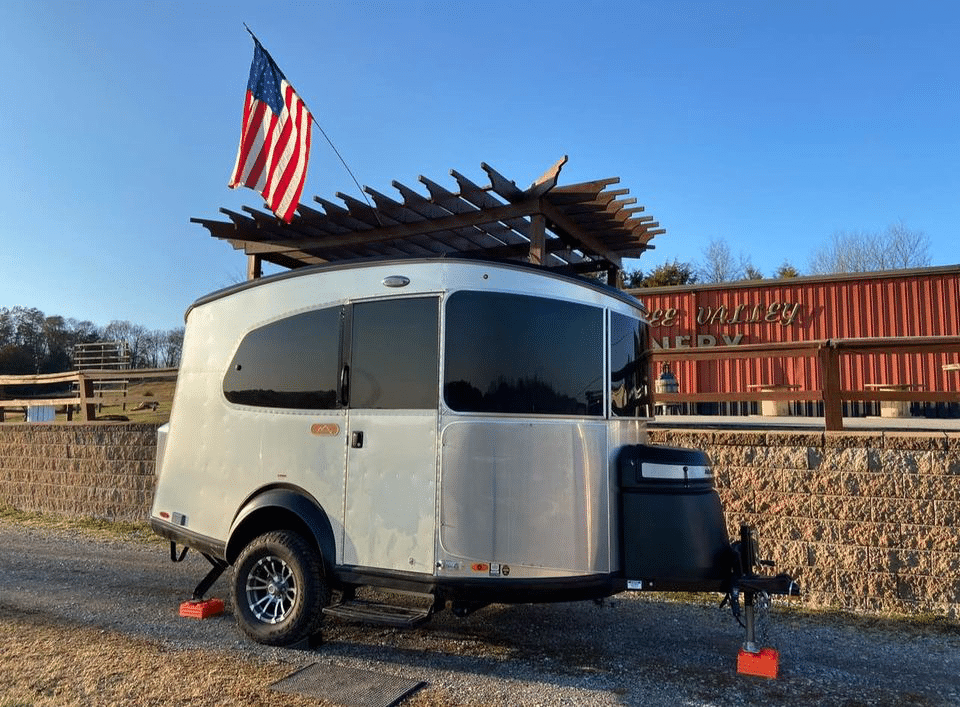
The Basecamp answers a specific question: what if a travel trailer could genuinely keep up with a truck on rough terrain? It’s Airstream’s smallest line, built on the same riveted aluminum shell the brand is famous for, just scaled down and reworked for adventure rather than comfort-first camping.
Instead of a full galley and a separate dry bathroom, the Basecamp uses a compact wet bath — shower, toilet, and sink sharing one waterproof space — which frees up room for what actually sets this trailer apart: an aluminum L-track cargo floor with tie-down points, and a rear swing hatch that turns the back of the trailer into a proper gear garage. Mountain bikes, kayaks, skis — it’s designed to haul the stuff you’re actually going somewhere to use.
It comes in two sizes. The 16-foot model is the lighter, easier tow at around 2,650–2,700 lbs dry, sleeping two on a rear bench that folds into a bed. The 20-foot model adds a front U-shaped dinette that can seat and sleep more people, plus extra cabinet storage, and lands closer to 3,400–3,500 lbs dry. Both are available with the off-road X-Package — a 3-inch suspension lift, Goodyear all-terrain tires, and stainless stone-guard protection — which is genuinely useful if “camping” for you sometimes means forest service roads rather than paved loops.
Quick specs (Basecamp 20): sleeps up to 4, about 20’2″ long, roughly 3,400–3,500 lbs dry, 4,300 lb GVWR, 535 lb hitch weight, no slideouts. Starting MSRP runs about $52,000–$58,000 depending on trim.
Where it makes sense: couples or small families whose trips actually involve rough roads and gear-hauling, who want the lightest, most towable option, and who value Airstream’s name recognition and resale strength.
The Oliver Legacy Elite II: Built for Comfort in Any Weather
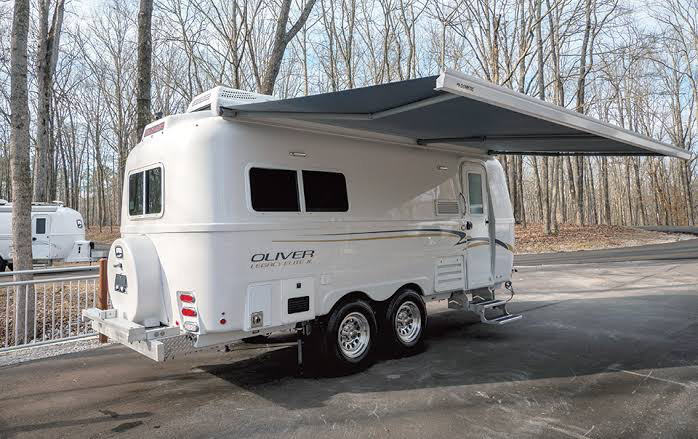
Where the Basecamp is built for rough roads, the Legacy Elite II is built for rough weather — and for owners who want a small trailer that lives like a much bigger one. Every unit is hand-built in Tennessee using Oliver’s signature double-hull molded fiberglass construction: two fiberglass shells with insulation packed between them, working a bit like a high-end cooler holds temperature. Plumbing and holding tanks sit enclosed between those hulls with heat tracing, which is a big reason Olivers are considered some of the most genuinely four-season-capable small trailers on the market.
Step inside and the differences from the Basecamp are immediate. You get a real dry bathroom with a porcelain toilet and an actual shower stall, not a shared wet bath. There’s a proper two-burner kitchen with a 2-way compressor refrigerator, and custom-built storage drawers throughout rather than adventure-style tie-down space. Buyers choose between two floor plans: the Standard, with a rear dinette that seats up to seven and converts into a king or twin bed, or the Twin Bed layout with two dedicated 75″x30″ twin beds and nightstands — a nice option for two people who don’t necessarily want to share a bed on every trip.
The chassis matters here too. Oliver runs tandem Dexter axles with quad gas shocks, which tows noticeably smoother than a comparable single-axle trailer — a real difference on long highway stretches, not just a spec sheet number.
Quick specs: sleeps 3–4 depending on floor plan, about 23’6″ long, roughly 4,900–5,465 lbs dry depending on floor plan and package, 7,000 lb GVWR, 490 lb hitch weight, no slideouts. Starting MSRP runs about $79,995–$80,000 new, with clean used examples typically $55,000–$78,000.
Where it makes sense: couples who prioritize comfort and true four-season capability over off-road toughness — full-timers, cold-weather campers, or anyone who wants a full bathroom and a smoother tow more than a gear garage.
So Which One Should You Actually Buy?
| Feature | Airstream Basecamp 20 | Oliver Legacy Elite II |
|---|---|---|
| Best For | Adventure, off-road travel & gear hauling | Comfort, four-season camping & longer trips |
| Length | Approx. 20’2″ | Approx. 23’6″ |
| Dry Weight | Approx. 3,400–3,500 lbs | Approx. 4,900–5,465 lbs |
| GVWR | 4,300 lbs | 7,000 lbs |
| Hitch Weight | Approx. 535 lbs | Approx. 490 lbs |
| Sleeping Capacity | Up to 4 | 3–4 |
| Bathroom | Compact wet bath | Full dry bathroom |
| Kitchen | Compact kitchen | 2-burner cooktop & compressor refrigerator |
| Bed Options | Convertible sleeping area | King/twin or dedicated twin-bed layout |
| Construction | Riveted aluminum shell | Double-hull molded fiberglass |
| Axles | Single axle | Tandem Dexter axles |
| Off-Road Package | X-Package available | Not primarily designed for off-road use |
| Gear Storage | Rear hatch & L-track cargo floor | Built-in interior storage |
| Four-Season Capability | Good, depending on configuration | Designed specifically for four-season use |
| Slide-Outs | No | No |
| Starting Price | Approx. $52,000–$58,000 | Approx. $79,995–$80,000 |
| Key Advantage | Lightweight, maneuverable & adventure-focused | Premium comfort, durability & weather protection |
It’s not really about which trailer is “better,” it’s about what kind of adventure you had in mind when you started thinking about using one.
The Basecamp is good if you see yourself in a rowdy adventure on a dirt road, mountain biking and reaping the benefits of a good rinse before passing out for the night. It’s made for just that sort of thing, and it’s lighter and cheaper than the Oliver.
The Legacy Elite II is good if you see yourself having a “real” bathroom after a long day of exploring, celebrating another October in the desert with a cozy trailer, and not minding the extra weight and the $25,000-$30,000 difference in price.
Both trailers will hold their value about as well as any small travel trailer can, so I wouldn’t get caught up in whatever economic or environmental argument you want to have about which model is “better.” Just decide which kind of adventures you want to have, then choose the model that fits your plans.