
The Keystone Hideout has been one of the best-selling entry-to-mid-level travel trailer lines in North America for years, and it’s easy to see why once you look past the price tag. Keystone builds the Hideout with the same core construction techniques it uses on its higher-end lines, then packages it into lighter, more affordable floorplans aimed at first-time buyers and value-focused families.
This review breaks down what the Hideout actually offers construction, weight, tank capacity, pricing, and the full range of floorplans across its Sport, Mini, East, and destination-trailer variants so you know exactly what you’re getting before you visit a dealer.
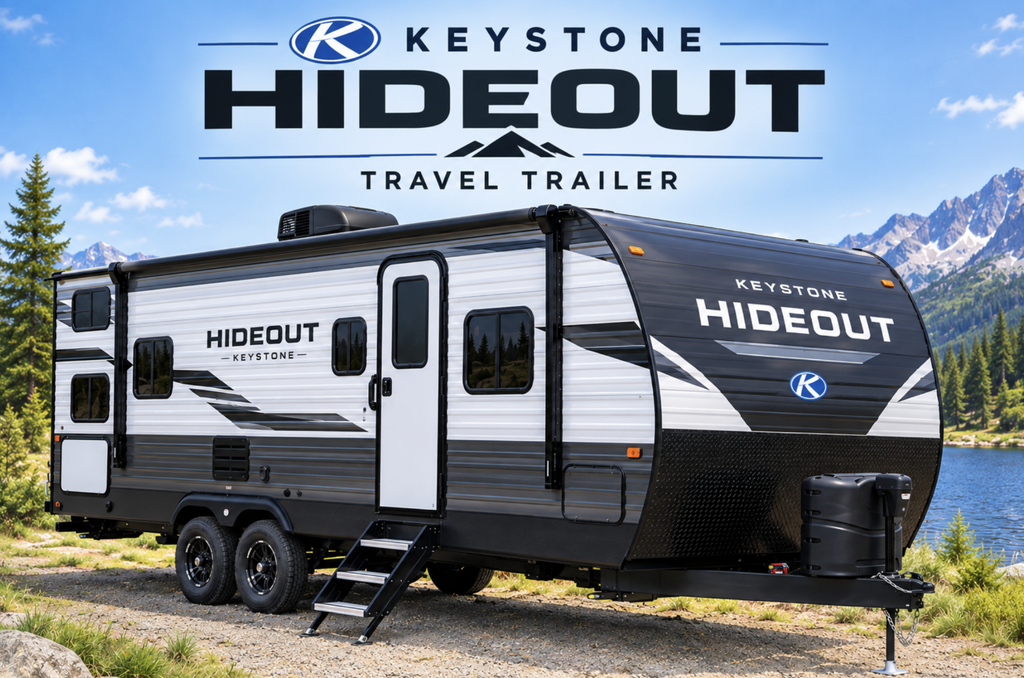
The Keystone Hideout has been one of the best-selling entry-to-mid-level travel trailer lines in North America for years, and it’s easy to see why once you look past the price tag. Keystone builds the Hideout with the same core construction techniques it uses on its higher-end lines, then packages it into lighter, more affordable floorplans aimed at first-time buyers and value-focused families.
This review breaks down what the Hideout actually offers construction, weight, tank capacity, pricing, and the full range of floorplans across its Sport, Mini, East, and destination-trailer variants so you know exactly what you’re getting before you visit a dealer.
Keystone Hideout at a Glance
| Category | Details |
| Trailer Type | Travel trailer (bunkhouse, couples, and rear-kitchen layouts) |
| Length Range | ~20′ – 32’+ depending on floorplan and sub-line |
| Dry Weight Range | ~3,500 – 7,100+ lbs |
| Sleeping Capacity | 4 – 8 |
| Starting MSRP | Low $20,000s (Hideout Sport/Mini) to mid-$50,000s (larger standard Hideout floorplans) |
| Frame Construction | I-beam frame with stamped steel cross-members and outriggers |
| Roof | Super Flex/AlphaPly TPO membrane, walkable, lifetime warranty |
| Floor | Dyna Span 5/8″ seamless floor decking, 25-year warranty |
| Underbelly | One-piece, enclosed underbelly |
| Structural Warranty | 3-year limited structural warranty, 1-year base warranty |
Keystone markets several sub-lines under the Hideout name, so pricing and specs vary meaningfully depending on which one you’re comparing — a detail worth understanding before assuming “Hideout” means one single product.
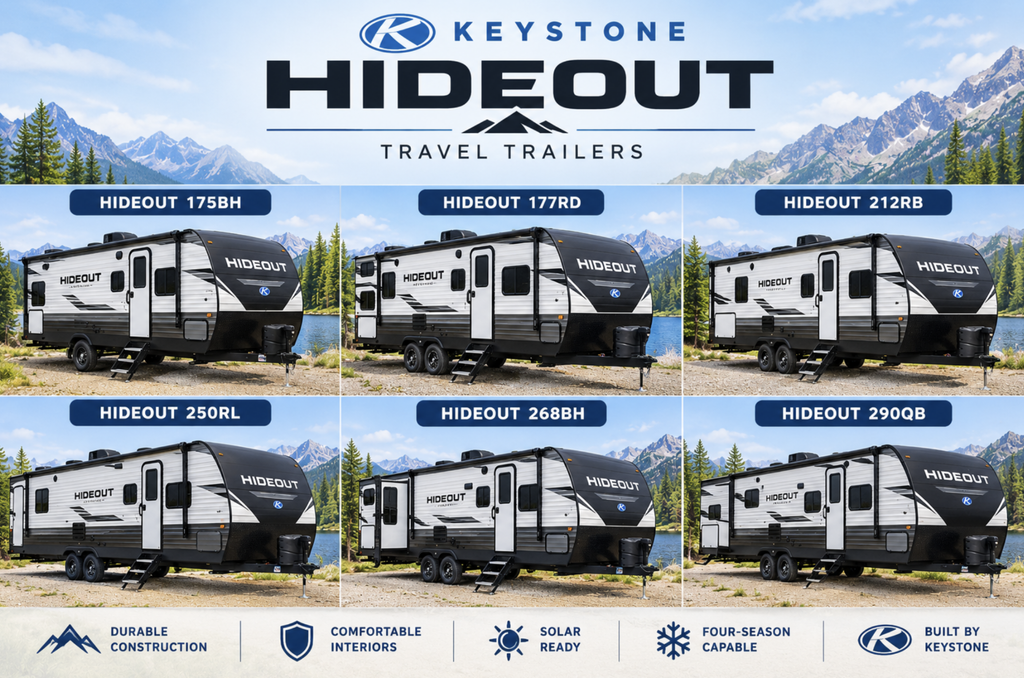
Construction: What’s Actually Under the Skin
Keystone built the Hideout with an I-beam frame with stamped steel cross-members and outriggers. Almost identical to the frame technology they use for their higher-end fifth wheels – which is a great value for the price point. On top of that, you have Dyna Span seamless floor decking, 5/8th” thick, 25-year warranty and a Super Flex (Alpha Ply if it’s a 2023) TPO roof membrane, completely walkable with lifetime warranty so you can get up there and fix the A/C or the vent if you need to.
The underbelly is all one piece and sealed up which is pretty cool – because that keeps the plumbing and holding tanks protected from road debris and the elements a lot better than having everything just hanging out underneath. Oh, and Keystone’s travel trailers like the Hideout travel trailer have in-floor heating ducts with Tuf-Lok thermoplastic duct joiners for most of the travel trailers. That means the heat from the furnace gets pushed to the floor rather than just being up in the ceiling.
For the price point, the Hideout’s frame and roof/floor warranties are a genuine step above bargain-basement travel trailers, even if the interior finishes reflect its position as an entry-to-mid-tier line rather than a premium one.
Weight and Towability
The Hideout lineup spans a wide weight range depending on which sub-line and floorplan you’re looking at:
- Hideout Sport / Hideout Mini (smallest floorplans, e.g., 181BH, 175BH): dry weights around 3,500–4,000 lbs, towable by a wide range of mid-size SUVs and light trucks
- Standard Hideout (mid-size floorplans, e.g., 22MLS, 24RBS, 25BHS): dry weights in the 5,600–6,400 lb range, generally suited to half-ton trucks and larger SUVs
- Larger Hideout floorplans (e.g., 28RKD): dry weights climbing past 7,000 lbs, which pushes into three-quarter-ton truck territory once loaded
This spread is actually one of the Hideout’s strengths — there’s a genuinely lightweight entry point in the Sport/Mini sub-line for buyers with smaller tow vehicles, and a heavier, more feature-rich option for buyers who want more space and don’t mind towing more weight.
Tank Capacity and Off-Grid Camping
Tank sizes scale with trailer size, as expected:
- Hideout Sport/Mini: fresh water around 21–34 gallons, gray and black around 30 gallons each — modest capacity suited to short trips or full-hookup camping
- Standard Hideout: fresh water commonly 46 gallons, gray water 39–78 gallons depending on floorplan, black water 30–39 gallons
The gray water capacity jump on larger standard Hideout floorplans (some reaching 69–78 gallons) is a notable advantage for campers who want to stretch multi-night stays without full hookups, while the smaller Sport/Mini units are clearly built with shorter trips and developed campgrounds in mind.
The Hideout Floorplan Lineup Explained
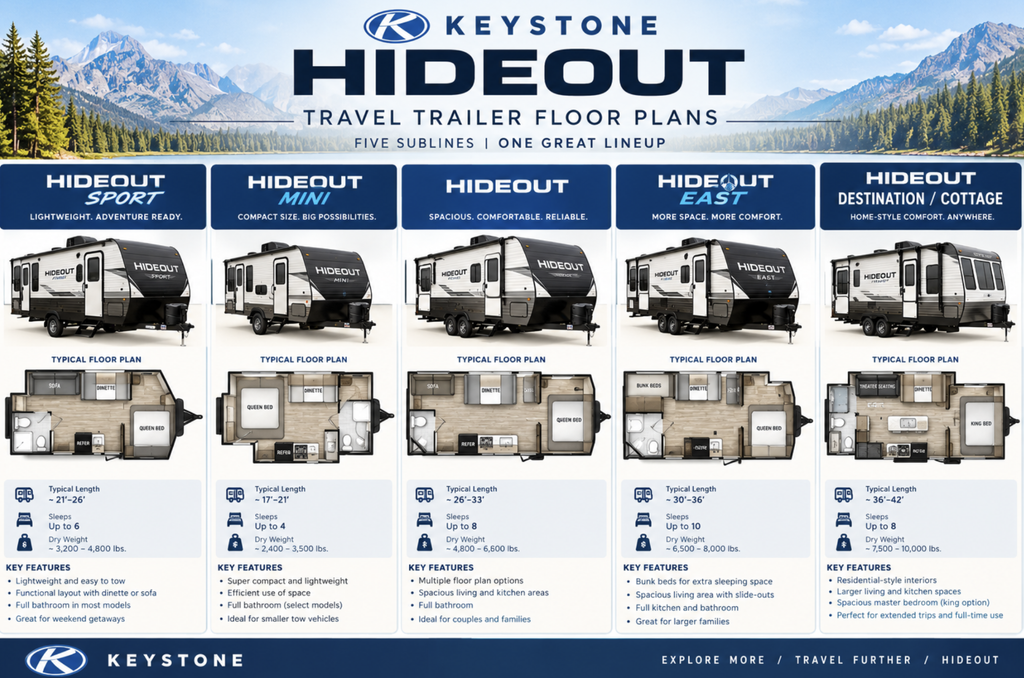
Keystone spreads the Hideout name across several distinct sub-lines, and knowing the difference will save you time at the dealer:
Hideout Sport / Hideout Mini: This is the ‘gateway’ to the family lineup. These are small floorplans that easily allow you to tow on a single-axle and that are typically under 23 feet. Ideal if you’re looking for the best price point and easiest tow weight. You will have a smaller fridge, smaller bathroom and less storage options, but the majority will include a functional bunkhouse, queen and full kitchen.
Standard Hideout: The core of the lineup, spanning roughly 22 to 32 feet with front-bedroom, rear-bath, rear-kitchen, and bunkhouse configurations. This is where most buyers land, offering a meaningful step up in tank capacity, storage, and furnace output (commonly 30,000 BTU) over the Sport/Mini sub-line.
Hideout East: Floorplans specifically tailored for East Coast dealer markets and camping conditions — generally similar in construction and features to the standard Hideout line, but with layout variations aimed at that regional buyer base.
Hideout Destination Trailer / Hideout Cottage: A whole new world of pain here-these are much larger units where you can’t just tow them off in any direction whenever you want. These are good for staying put at a campground or seasonal property. So, they’ll have things like larger refrigerators and bigger fireplaces, and spacious living areas.
Interior Features and Livability
In all the towable Hideout lines, Keystone keeps it pretty consistent with standard features. Think solid wood cabinet doors and drawers, one-piece pressed countertops with matching backsplash, and blackout night shades and Flex Storage lets you customize cabinets and drawers with adjustable organization.
What’s the best of the new? Off-the-grid options like Solar Flex solar prep, lithium-ready converters, and tankless water heaters in select floorplans…once limited to high-end trailers.
The interior fit and finish is straightforward rather than upscale — this isn’t a trailer built to compete with premium fiberglass-and-aluminum-framed lines on cabinetry or countertop materials. What it does deliver is a lot of functional camping features for the price, which is exactly the segment Keystone is targeting.
Price: What You’ll Actually Pay
MSRP across the Hideout lineup varies widely by sub-line and floorplan:
- Hideout Sport/Mini: MSRP typically in the high-$20,000s to mid-$30,000s, though dealer discounts and clearance pricing regularly bring these into the mid-teens
- Standard Hideout: MSRP generally ranges from the low $40,000s to mid-$50,000s depending on length and features
- Larger floorplans with more slides and features: can approach or exceed $53,000 MSRP
Just like most travel trailers, real selling prices are generally much below MSRP, especially Sport/Mini floorplans which are often deeply discounted by the dealer in order to shift the inventory. Be sure to look into the real out-the-door price at multiple dealers before comparing the MSRP.
Pros and Cons
What the Hideout does well:
- Strong frame, roof, and floor warranties relative to its price point
- Wide range of sizes and weights, from sub-4,000-lb entry units to more feature-rich 30-foot-plus floorplans
- One-piece enclosed underbelly and in-floor heat ducts add real cold-weather usability for the price class
- Consistent standard feature set (Flex Storage, unified wiring, TPO roof) across most of the lineup
Where it falls short:
- Interior materials and finishes are functional rather than upscale, especially on Sport/Mini floorplans
- Smaller tank capacities on entry-level units limit extended off-grid use
- As with most high-volume entry-level trailers, some owners report minor fit-and-finish inconsistencies and appliance issues that are worth checking closely on a pre-purchase inspection
Who the Keystone Hideout Is For
The Hideout makes the most sense for:
- First-time RV buyers who want a well-supported, widely available brand without paying premium pricing
- Families who need a bunkhouse layout but are working with a tighter budget or a smaller tow vehicle
- Buyers who prioritize frame and structural warranty coverage over high-end interior materials
It’s a weaker fit for:
- Buyers planning extensive off-grid or full-time living, where the entry-level sub-lines’ smaller tanks and lighter-duty components will show their limits faster
- Anyone shopping primarily on interior fit-and-finish rather than price and functional features
Frequently Asked Questions
How much does a Keystone Hideout cost? Pricing spans a wide range: Hideout Sport/Mini floorplans start in the high-$20,000s to mid-$30,000s MSRP (often discounted lower), while standard Hideout floorplans generally run from the low $40,000s to mid-$50,000s MSRP depending on length and features.
What’s the difference between Hideout, Hideout Sport, and Hideout Mini? Hideout Sport and Hideout Mini are Keystone’s lightweight, entry-level sub-lines, typically under 23 feet with smaller tanks and simpler features. The standard Hideout line offers larger floorplans, bigger tanks, and more storage, generally in the 22- to 32-foot range.
Is the Keystone Hideout a good trailer for full-time living? It can work for light or seasonal full-time use, particularly on larger standard Hideout floorplans with bigger tanks, but its entry-level positioning means it’s not built with the tank capacity or heavy-duty components that dedicated full-time trailers offer.
What warranty does the Keystone Hideout come with? Keystone backs the Hideout with a 3-year limited structural warranty and a 1-year base warranty, plus separate manufacturer warranties on the roof membrane (lifetime, walkable) and floor decking (25 years).
Conclusion
The Keystone Hideout has been a favorite for years because it offers excellent value for money. The all-steel reinforced I-beam frame, roof with a lifetime warranty, and flooring with a 25-year warranty are hard to match at that price point in my book. There are a few less desirable points to note, such as lacking the plush interiors of the high-end fiberglass-and-aluminum trailers, and the Sport/Mini models having tank and storage limitations.
But the value of a bunkhouse trailer you don’t have to pay a premium for makes the Keystone Hideout an excellent choice. Just make sure to pick the right floorplan and model that will suit your needs for camping and the tow vehicle.