
If you fly often enough, a carry-on stops being an accessory and becomes equipment. It gets thrown into overhead bins several hundred times a year, dragged over cobblestones and airport carpet, crammed into regional jet bins, and measured by gate agents who are under more pressure to enforce sizing than they were two years ago. Most luggage sold as “carry-on” is not built for that, and the failure points are predictable: wheels first, then telescoping handles, then zippers.
This guide covers the best carry-on luggage for frequent flyers, with current specs, weights and prices. It starts with the thing that catches most buyers out, which is that the bag advertised as 21 or 22 inches is almost certainly larger than that once you measure it the way an airline does.

The Sizing Trap: Case Dimensions vs Overall Dimensions
Luggage brands publish two sets of numbers, and only one of them matters at the gate. Case dimensions describe the packing body alone. Overall dimensions include the wheels and the carry handles. Airlines measure the second one.
Travelpro is unusually transparent about this. Their Platinum Elite 21-inch carry-on has case dimensions of 21 x 14 x 9 inches, which sounds comfortably inside the standard limit. The overall dimensions, wheels and handles included, are 23.5 x 14.5 x 9 inches. That is an inch and a half over the commonly published 22 x 14 x 9 standard, and Travelpro says so plainly on their own product page while noting the bag is sizer-bin tested and does fit the sizes and mainline bins of major US carriers.
Most premium carry-ons are in the same position. The practical upshot is threefold. Compare overall dimensions to airline limits, never case dimensions. Treat any bag marketed at exactly 22 inches with suspicion unless the brand specifies which measurement that is. And accept that regional jets have smaller bins, so you will gate-check on those flights regardless of what you bought.
The expansion zipper deserves the same scrutiny. A bag that fits the sizer packed flat will not fit expanded, and brands say so in their own fine print. Treat expansion as capacity for checked trips, not for the overhead bin.
Carry-On Size Limits by Airline
There is no universal standard. IATA recommends a cabin bag of 55 x 35 x 20 cm, and most airlines ignore it in favor of their own numbers. Here is where the major carriers stand.
| Airline | Cabin Bag | Personal Item | Watch Out For |
|---|---|---|---|
| American, Delta, United, Alaska, JetBlue | 22 x 14 x 9 in (56 x 36 x 23 cm) | 18 x 14 x 8 in | United Basic Economy domestic allows a personal item only |
| Southwest | 24 x 16 x 10 in | Standard under-seat | The most generous US limit |
| Spirit, Frontier | 24 x 16 x 10 in, paid | 18 x 14 x 8 in, free | Overhead access is a separate purchase |
| Ryanair | 55 x 40 x 20 cm, 10 kg, Priority required | 40 x 30 x 20 cm, free | Sizers used routinely; gate fees are steep |
| easyJet | 56 x 45 x 25 cm on higher fares | 45 x 36 x 20 cm, up to 15 kg, free | The most generous free under-seat bag in Europe |
| Wizz Air | 55 x 40 x 23 cm with Priority | 40 x 30 x 20 cm, free | Structure mirrors Ryanair |
| British Airways | 56 x 45 x 25 cm, up to 23 kg | 40 x 30 x 15 cm | Two bags included on most fares |
| Most non-US carriers | Varies, often 55 x 40 x 23 cm | Varies | Weight caps of 7–10 kg are actively enforced |
Two patterns matter for buyers. First, US limits are dimensional only, with no weight cap on domestic routes, while most international carriers enforce weight limits of roughly 7 to 10 kg. That flips the buying logic entirely: on European routes, a heavy bag eats your allowance before you have packed anything. A carry-on weighing 3.5 kg empty leaves only about 3.5 kg of clothes under a 7 kg cap.
Second, on European budget carriers the free allowance is usually the under-seat bag, not the cabin bag. Overhead access is sold separately through Priority or a higher fare tier, so the bag that clears the rules is often much smaller than the one you already own.
What Changed in 2026
The published size limits have mostly stayed put. Enforcement has not. Airlines have moved away from the honor system toward measuring bags at the gate, and budget carriers in particular now run passengers through sizer frames as a matter of routine rather than during busy boarding only.
In Europe the rules are actively in flux. Airlines for Europe, the trade group whose members include Ryanair, easyJet and TAP, adopted a standard minimum under-seat bag size of 40 x 30 x 15 cm, and Ryanair enlarged its free under-seat allowance to 40 x 30 x 20 cm in response. easyJet has said it will keep its more generous 45 x 36 x 20 cm allowance rather than shrink to the new minimum.
The bigger reform, which would guarantee every passenger a free under-seat bag plus a larger cabin bag of up to 100 cm total dimensions and 7 kg, has moved through the EU legislative process during 2026 but reporting on its exact status has been inconsistent, with some outlets describing an agreement and others describing continuing negotiation. Nothing has changed at the gate yet as a result of it. Check your specific airline and fare before you book rather than relying on the headlines.
One practical consequence: a bag sized to 40 x 30 x 15 cm clears the free under-seat allowance on essentially every European carrier. If most of your flying is short-haul European budget routes, that is the number to buy to, not 55 x 40 x 20 cm.
The Best Carry-On Luggage for Frequent Flyers
1. Travelpro Platinum Elite 21″ — Best Overall
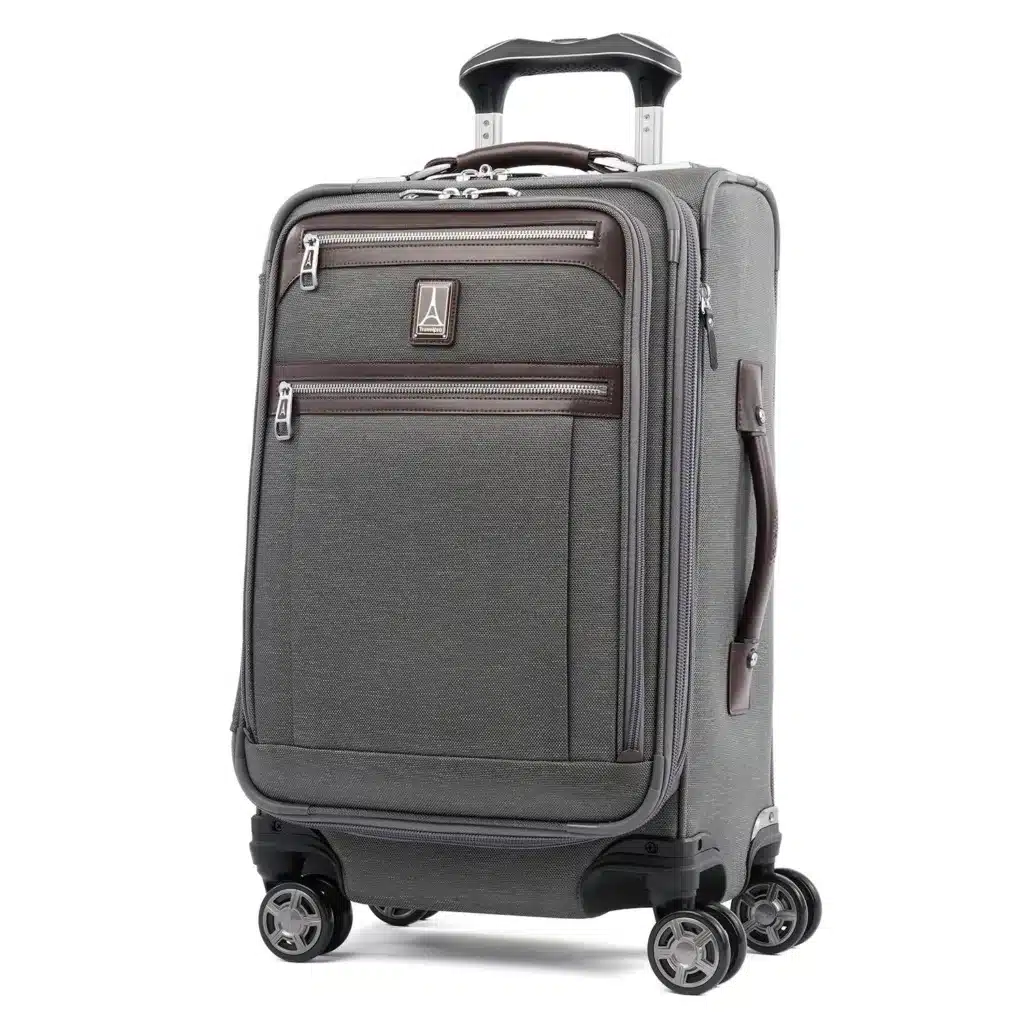
Specs: Case 21 x 14 x 9 in; overall 23.5 x 14.5 x 9 in; 7.8 lb stated, measured at 8.1 lb by OutdoorGearLab; 46L; ballistic-style high-density fabric with Duraguard coating; 2 in expansion; USB-A and USB-C ports with a dedicated power-bank pocket; lifetime limited warranty; around $350–400
Travelpro built its business around airline crew, and the Platinum Elite is what that heritage produces. The PrecisionGlide system uses eight MagnaTrac self-aligning spinner wheels, and the PowerScope aluminum handle has four height stops at 36, 38, 40 and 42.5 inches, which matters more than it sounds if you are notably tall or short. A drop-in fold-out suiter handles a jacket without creasing it.
The soft exterior is the underrated advantage for frequent flyers. It compresses into a tight bin in a way a rigid shell cannot, which is the difference between stowing your bag and gate-checking it on a full flight. The trade is weight: at around 8 pounds it is heavier than most hardside competitors, which counts against you on weight-limited international routes.
2. Briggs & Riley Baseline Essential — Best Warranty
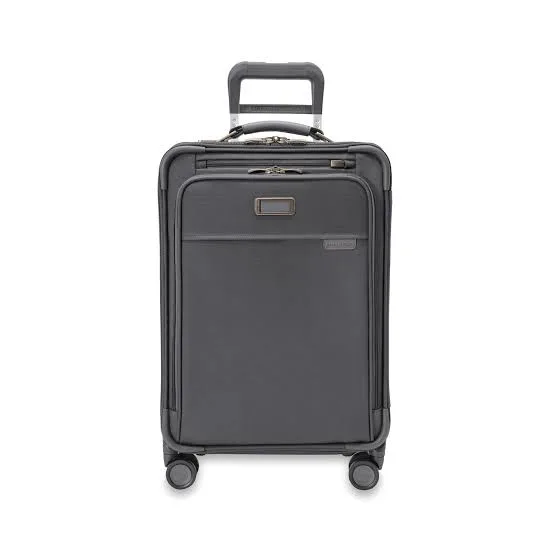
Specs: 22 x 14 x 9 in including wheels; interior 21 x 14 x 7.875 in; 9.7 lb; ballistic nylon; CX compression-expansion to 11.5 in depth; Outsider external handle for a flat packing surface; guaranteed for life including airline damage; around $650–730
Briggs & Riley’s warranty is the reason this bag exists on lists like this. It is unconditional and covers damage caused by airlines, which is the failure mode that kills most luggage and which nearly every other warranty excludes. If you fly weekly, the cost per year of ownership is lower than a bag you replace every three years.
The engineering backs it up. The Outsider handle system runs the telescoping mechanism on the outside of the bag, leaving a flat interior packing surface rather than the ridges that force awkward packing in most softside cases. CX compression expands the bag and then compresses it back down. At 9.7 pounds it is the heaviest bag here, which is the honest cost of that build.
3. Away The Bigger Carry-On — Best Hardside All-Rounder
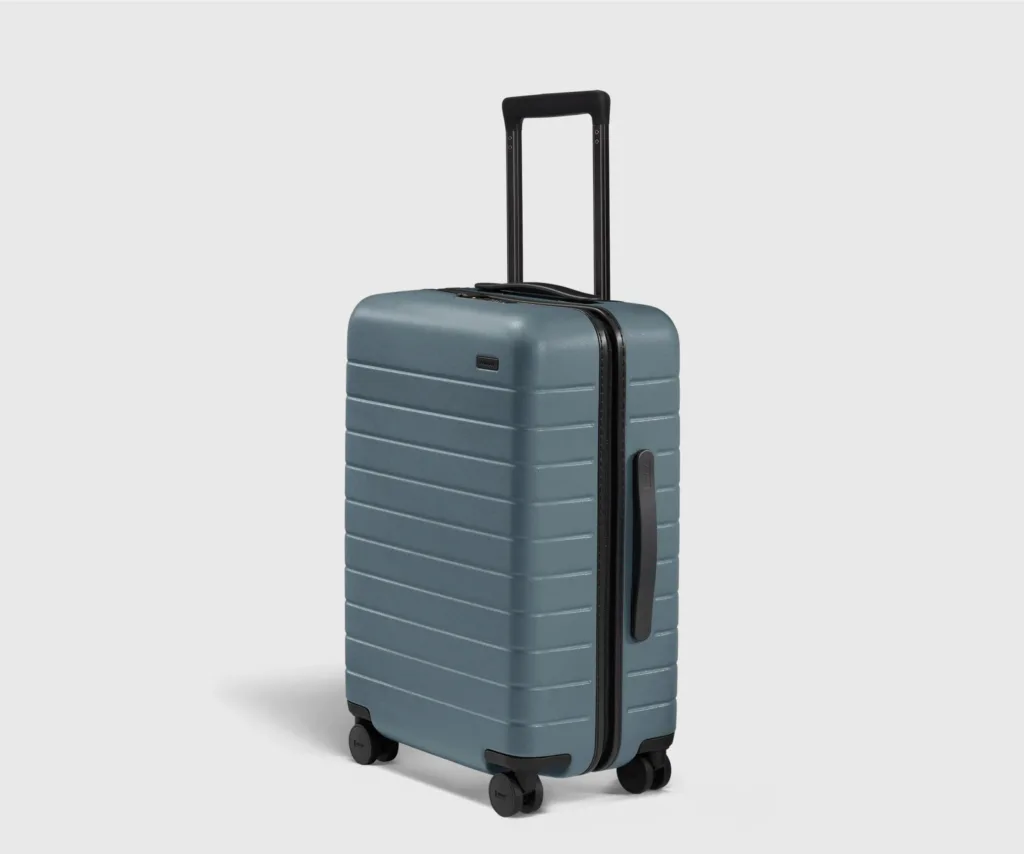
Specs: Approximately 55 x 39 x 23 cm; roughly 8–9.5 lb depending on configuration; polycarbonate shell; interior compression system and included laundry bag; battery version available with removable USB-C charger; 100-day trial; around $295–325
Away is the bag most people picture when they think direct-to-consumer luggage, and the Bigger Carry-On is the version worth owning. Forbes Vetted named it their top overall pick after testing, citing the organizational features, built-in compression and enough capacity for a full week. The polycarbonate shell has close to a decade of field data behind it now.
Two things to know. The battery is not standard across the range, so if USB charging matters, check the specific model. And it is a big carry-on, sized to use every inch of the US allowance, which means it is a poor fit if much of your flying is European budget routes.
4. Monos Carry-On Pro — Best for Laptop Access

Specs: Makrolon polycarbonate shell; Hinomoto silent-glide wheels; external zippered laptop compartment; vegan-leather grab handles and compression straps; lifetime limited warranty with mail-in repair; around $255–325
The Pro’s external laptop compartment is the feature that earns it a place here. Hardshell cases almost never have exterior storage, so being able to reach a laptop, passport and documents without opening the whole case on a terminal floor is a real workflow improvement. OutdoorGearLab singled this out as the bag’s standout feature.
Monos sits in the same price bracket as Away with a slightly more premium feel, and the Hinomoto wheels are a genuine upgrade over generic hardware. The compartment is not large, so treat it as a document and device pocket rather than a full laptop bag replacement.
5. Travelpro Platinum Elite International — Best for European Carriers
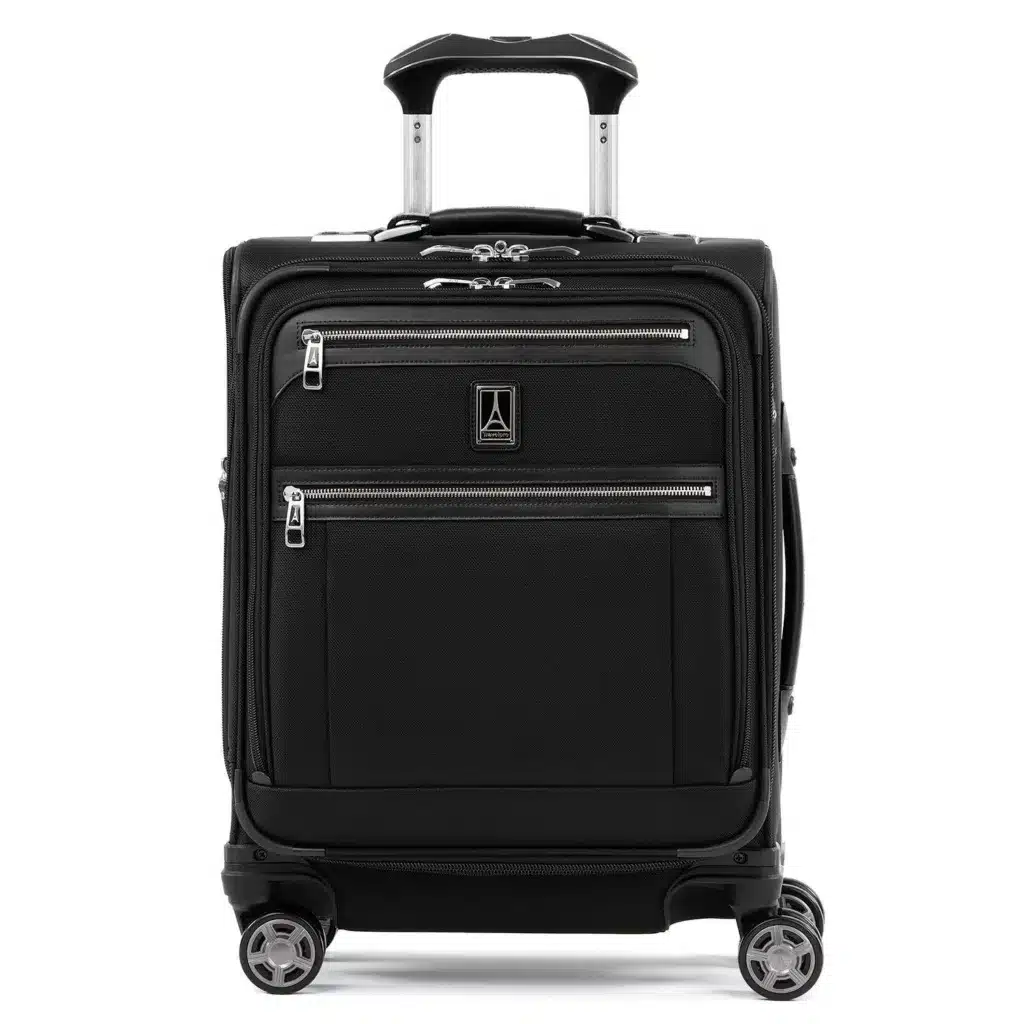
Specs: Case 19 x 15 x 7.75 in; overall 21.75 x 15.75 x 7.75 in; 7.7 lb; same fabric, wheels and warranty as the standard Platinum Elite
This is the version most guides skip and frequent international flyers should look at first. It is shorter and shallower than the domestic 21-inch model, built specifically to clear the tighter limits enforced by international carriers, and it weighs marginally less while doing it.
If your flying splits between US domestic and European short-haul, this is the more useful single bag. You give up some capacity on domestic trips in exchange for not gate-checking in Europe, which is a trade most frequent flyers would take.
6. Rimowa Essential and Original Cabin — Best Premium

Specs: Essential Cabin: polycarbonate, approximately 7 lb, from around $735. Original Cabin: aluminum, approximately 9–9.7 lb, 55 x 40 x 23 cm, from around $1,025. Stageless telescoping handle; Multiwheel system; global boutique repair network
Rimowa’s functional advantages are weight and repair access. The Essential Lite cabin is among the lightest quality carry-ons available, which matters directly under European weight caps, and the stageless handle adjusts to any height rather than fixed stops. The boutique repair network means service in most major cities rather than mailing your bag away.
The aluminum Original is a different proposition. It is heavier, more expensive and designed to accumulate dents and scratches as character rather than damage. For travelers flying 15 or more times a year who intend to keep a bag for a decade, the economics are defensible. Below that frequency, the Away or Monos does most of the same work for a fraction of the price.
7. Monos or Away Aluminum — Best Aluminum Under $700
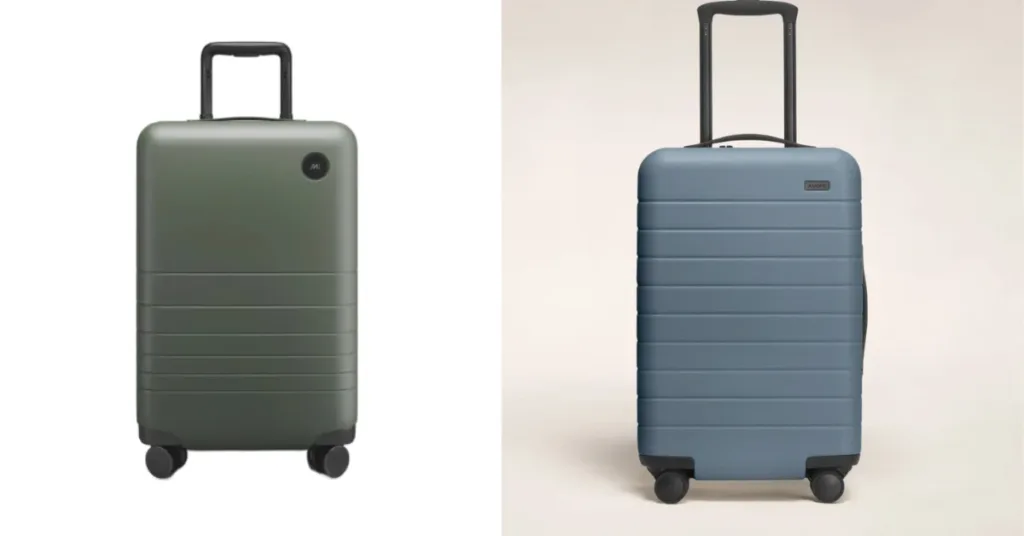
Specs: Monos Aluminum Carry-On Plus around $665; Away The Bigger Carry-On Aluminum Edition around $645; both roughly 10 lb; latch closure rather than zipper
If the aluminum aesthetic is the point but four figures is not, both Monos and Away build aluminum cases at roughly half of Rimowa pricing. Forbes Vetted puts the two within about twenty dollars of each other, which makes the choice a matter of styling rather than value.
Aluminum brings real trade-offs. These are the heaviest bags in the category, they dent rather than flex, and the latch closures are more secure but less forgiving than zippers when you have overpacked.
8. Samsonite Freeform or Omni 2 — Best Value
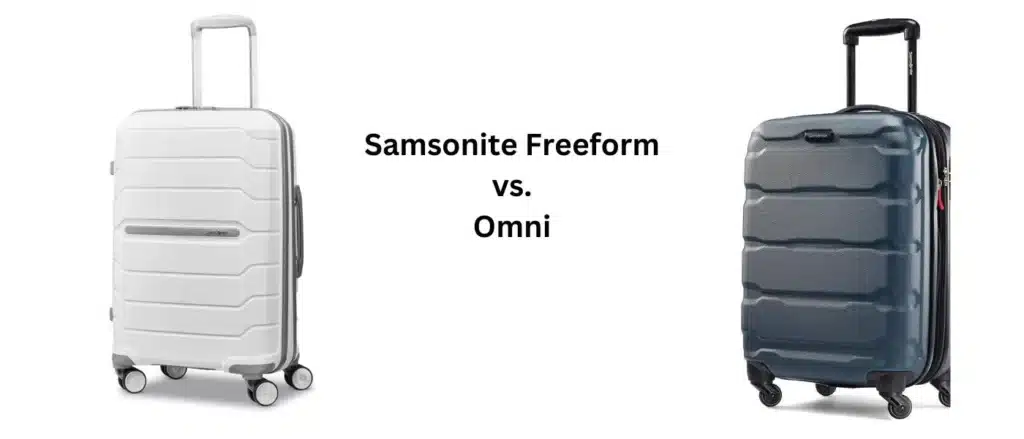
Specs: Freeform: polypropylene shell, under 7 lb, around $130–150. Omni 2: polycarbonate hardside, around $130
Not everyone reading this actually flies weekly. If you take four or five trips a year, a $700 bag is difficult to justify, and Samsonite has been building luggage long enough to make a competent one at a fifth of the price. Forbes Vetted picked the Freeform as their best value carry-on under $150.
Set expectations accordingly. A budget carry-on typically lasts two to four years of regular travel, against five to eight for a mid-range bag. The wheels usually go first. For occasional use that is a perfectly reasonable trade.
Carry-On Luggage Compared
Prices below are approximate and move constantly with sales, retailer discounting and model updates. Weights are as published unless noted. Always confirm current pricing and the overall dimensions of the exact model before buying.
| Model | Type | Weight | Approx. Price | Best For |
|---|---|---|---|---|
| Travelpro Platinum Elite 21″ | Softside | 7.8–8.1 lb | $350–400 | Frequent domestic flyers |
| Briggs & Riley Baseline Essential | Softside | 9.7 lb | $650–730 | Buy-it-for-life warranty |
| Away The Bigger Carry-On | Hardside | approx. 8–9.5 lb | $295–325 | Maximum packing space |
| Monos Carry-On Pro | Hardside | approx. 8 lb | $255–325 | External laptop access |
| Travelpro Platinum Elite International | Softside | 7.7 lb | $350–400 | European carriers |
| Rimowa Essential Cabin | Hardside | approx. 7 lb | $735 and up | Premium build, light weight |
| Rimowa Original Cabin | Aluminum | approx. 9–9.7 lb | $1,025 and up | Aluminum at any cost |
| Monos or Away aluminum | Aluminum | approx. 10 lb | $645–695 | Aluminum on a budget |
| Samsonite Freeform or Omni 2 | Hardside | under 7 lb | $130–150 | Occasional travelers |
Hardside or Softside?
Hardside polycarbonate protects fragile contents, wipes clean, resists water and looks modern. Softside nylon is more flexible, usually expands further, holds external pockets for the things you need mid-flight, and squeezes into a full overhead bin when a rigid shell will not.
The pattern among frequent business travelers leans softside, largely for the garment suiter and the exterior pockets. Travelers prioritizing durability against drops and weather lean hardside. Neither is wrong, and the more important variables are the wheels, the handle and the warranty, since those are what actually fail.
Buying Tips for Frequent Flyers
- Buy for your strictest airline, not your most common one: a bag that clears Ryanair clears everything. A bag that clears Delta may not clear anything in Europe.
- Weigh the empty bag before you buy: under a 7 kg international cap, every pound of suitcase is a pound of clothes you cannot bring. The spread between the lightest and heaviest bags here is roughly three pounds.
- Prioritize wheels and handles over features: these are the first components to fail. Hinomoto wheels, used by Monos, July and Level8, have a better reputation for longevity than generic hardware.
- Read what the warranty excludes: most warranties exclude airline handling damage, which is the damage you will actually get. Briggs & Riley covering it is the exception, not the norm.
- Check whether repair is mail-in or in person: mail-in repair means weeks without your bag. Brands with physical service networks are worth more to someone flying constantly.
- Ignore the expansion zipper when sizing: brands state in their own fine print that an expanded carry-on may not meet airline restrictions.
- Wait for a sale on the mid-tier brands: Away, Monos and Travelpro discount regularly. Premium and heritage brands rarely do.
- Consider two bags rather than one compromise: many frequent flyers end up with a domestic-sized bag and a smaller international one. That is often cheaper than replacing a single bag that fits neither well.
Choosing the Right Carry-On
For most frequent flyers on US domestic routes, the Travelpro Platinum Elite is the safe answer: crew-grade hardware, a suiter, and a soft shell that fits when the bin is nearly full. If you fly weekly for a living and want to buy once, the Briggs & Riley warranty makes it the cheapest bag here measured per year of ownership. If you want a hardshell, the Away Bigger Carry-On and Monos Carry-On Pro are the two worth comparing, and the Monos external laptop pocket is the tiebreaker if you work while traveling.
If a meaningful share of your flying is European short-haul, ignore all of that and buy to the size limit instead. The international-spec Travelpro, or something sized to the 40 x 30 x 15 cm under-seat standard, will save you more money in avoided gate fees than any feature on a larger bag will ever save you in convenience.
Specifications and prices reflect published information as of the 2026 model year and are approximate. Luggage pricing changes frequently with sales and retailer discounting, and airline baggage policies are revised regularly, particularly in Europe. Confirm the overall dimensions of the specific model and your airline’s current policy before purchase and before travel.